

Contact centers in regulated industries such as financial services, insurance, healthcare, utilities, and government face mounting pressure to deliver accurate, compliant responses across multiple channels. According to a new report from Upland Software, the gap between knowledge requirements and existing tools has become a defining challenge in modern service operations.
The report, titled "Regulated Industries Demand Governed AI Knowledge Delivery," argues that most contact centers do not lack content. Policies, scripts, procedures, regulatory guidance, and training materials exist in abundance. The problem is operational: that content is fragmented across intranets, document repositories, training platforms, and informal team resources, and it changes constantly. Products update, regulations shift, promotions launch, and policies are revised—and every change must reach every agent, every channel, and every self-service touchpoint without delay.
When propagation breaks down, consequences are measurable. Agents provide inconsistent answers, compliance gaps surface in regulated workflows, new hires struggle to ramp up, and customer satisfaction declines as the same question receives different responses depending on who handles it.
Traditional knowledge bases were built around the model of an agent stepping away from a conversation to search for information. In a modern contact center where handle time is measured in seconds and conversations span chat, voice, video, and social channels simultaneously, that model is no longer practical. Agents need answers to appear within the flow of work, contextually, without manual searching.
Static knowledge tools also struggle with governance at scale. Without structured review cycles, ownership assignments, and usage analytics, content quality deteriorates over time. Outdated answers remain active, conflicting versions accumulate, and the knowledge base shifts from a source of truth into a source of operational risk.
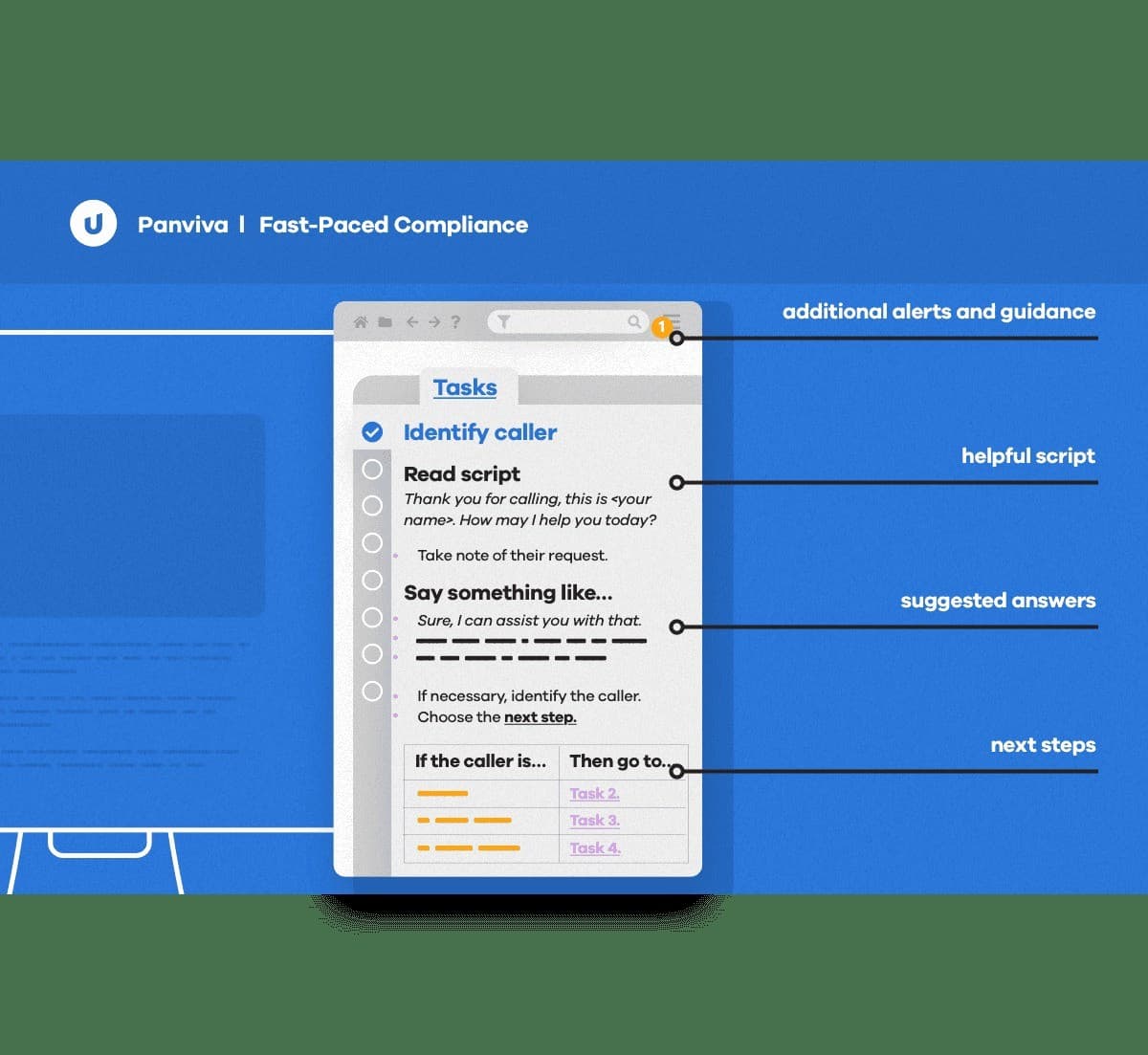
AI knowledge management platforms address these challenges by combining a governed content foundation with intelligent delivery. Rather than requiring agents to search, modern platforms surface relevant content based on conversation context, customer profile, and the specific task at hand. Step-by-step process guidance walks agents through complex procedures in real time, ensuring compliance steps are completed and that the experience remains consistent across the team.
Capabilities that distinguish AI knowledge management from earlier tools include natural language search and answer generation grounded in approved content, in-application delivery into agent desktops and contact center platforms, multi-channel publishing so the same approved knowledge supports chatbots, virtual agents, and customer self-service portals, and analytics that identify which content is resolving cases and where knowledge gaps exist.
Panviva, a platform by Upland Software, operates within this category as an AI knowledge management platform designed for contact centers and customer service operations that require accurate, in-the-moment guidance across agent and self-service channels. For organizations in regulated industries, knowledge accuracy extends beyond productivity—it is a compliance and risk function. A misquoted policy, a missed disclosure, or an outdated procedure can create regulatory exposure, customer disputes, or remediation costs that far exceed the operational gains of a faster contact center.
As contact centers expand their use of AI assistants, virtual agents, and automated case handling, the value of well-governed knowledge has increased accordingly. Every AI-powered customer interaction is only as accurate as the knowledge base supporting it—and that knowledge base must be the same trusted source human agents depend on. AI knowledge management increasingly serves as the foundation that makes contact center AI consistent and credibly deployable at scale.
