

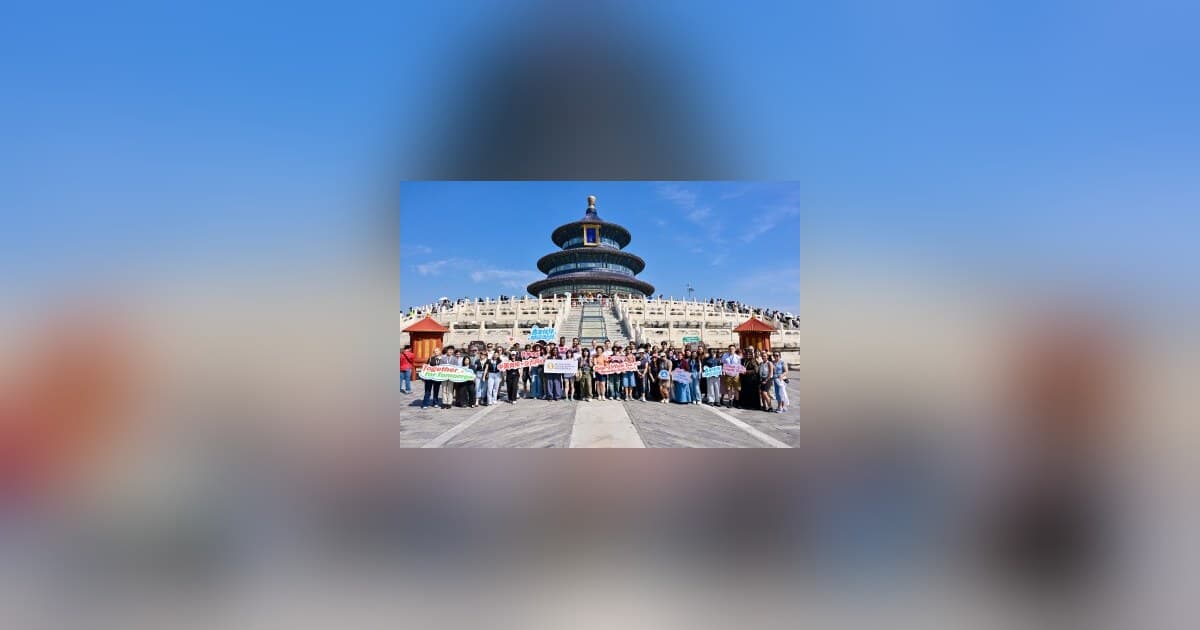
As U.S. and Chinese leaders prepare to meet in Washington D.C. this week, nearly 100 American college students have returned home after a week-long exchange program in China, carrying with them new friendships and a renewed sense of shared purpose. The students, from 10 U.S. universities, participated in the Future Makers 2026 China-U.S. Youth Tour for a Shared Asia-Pacific Future, organized by the Ng Teng Fong Charitable Foundation and the Beijing NGO Network for International Exchanges. The program, held September 1–7, brought together 170 young people from both countries for cultural exploration, direct dialogue, and technology visits across Jinan, Qufu, and Beijing.
At the close of the trip, the American students wrote to President Xi Jinping, sharing how the experience had shaped their understanding of both nations and expressing their hope to serve as "ambassadors of friendship across the Pacific." On September 21, President Xi replied personally, encouraging young people from both countries to carry forward friendship and work toward a better shared future. The exchange underscores the potential of people-to-people ties to bridge differences, especially as geopolitical tensions persist.
Participating institutions included American University, Central Michigan University, Columbia University, Harvard University, Kentucky State University, Saint Peter's University, the University of California Davis, the University of California Riverside, the University of Chicago, and the University of Washington. Many students said they previously knew China mainly through headlines and social media, but found "the real China" — young people who share similar tastes, pressures, and dreams. Jackson Kreisner of American University remarked, "American and Chinese youth are much more similar than we are different — we listen to the same music, eat the same food, feel the same emotions, share the same dreams." Ainsley Reigler of Central Michigan University added that discussing U.S.-China relations with peers from different backgrounds was an experience she could never have replicated in a classroom.
The itinerary included visits to Qufu, the birthplace of Confucius, where students explored the concept of "harmony in diversity," and Tsinghua University in Beijing, where they exchanged views on youth responsibility, technological innovation, and Asia-Pacific cooperation. The program also offered firsthand insights into China's tech advances, with visits to Beijing E-Town Robot World, the Beijing High-Level Autonomous Driving Demonstration Area, and the Xiaomi Auto Factory.
A highlight was the establishment of the "Forest for Tomorrow" at Yanqi Lake in Beijing, where American and Chinese youth planted white-bark pine trees together, symbolizing enduring friendship between the younger generations. The Ng Teng Fong Charitable Foundation fully funded the program for all American participants, enabling students from diverse backgrounds to experience China firsthand.
Mr. Daryl Ng, Director of the Ng Teng Fong Charitable Foundation and Chairman of Sino Group, said: "During the program, I had the opportunity to join the American participants on a visit to the Temple of Heaven and spend time speaking with them directly. I was deeply impressed by their curiosity about Chinese culture and their interest in the country's development. Inspired by President Xi's message, we will continue to support international youth exchanges and dialogue, and do our part to foster greater understanding, friendship, and people-to-people connections across borders. We will also leverage Hong Kong's unique role as a 'super-connector' to further strengthen exchanges between China and the rest of the world."
The initiative, publicized via Media OutReach Newswire, comes at a critical time for U.S.-China relations. By investing in youth exchanges, the foundation aims to build a foundation of mutual understanding that can transcend political differences. As the two nations navigate complex diplomatic terrain, such people-to-people connections may prove essential in reducing misperceptions and fostering cooperation on global challenges. For the students involved, the experience has already changed their perspectives — and they return home not just with memories, but with a mission to bridge the Pacific divide.
