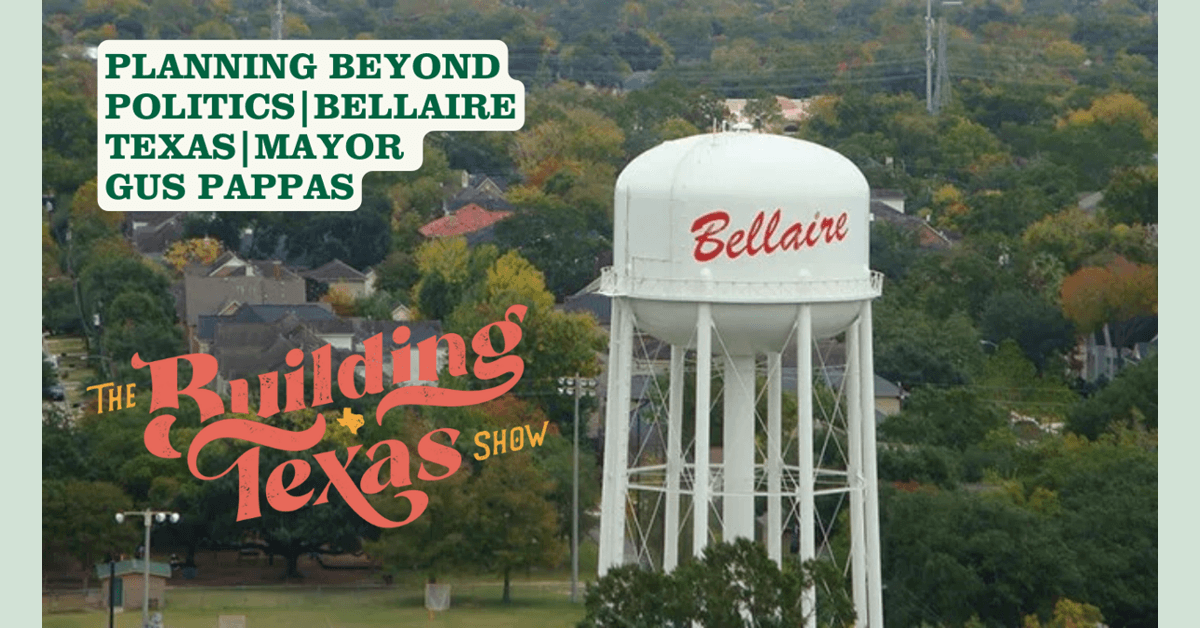
The Building Texas Show released a comprehensive interview with Bellaire Mayor Gus Pappas examining how the city maintains its status as one of Houston's most intentionally planned communities despite being fully built-out and unable to expand geographically. Recorded on location, the conversation reveals how Bellaire approaches growth through infrastructure investment, zoning discipline, and preservation of community character rather than territorial expansion.
Mayor Pappas, recently re-elected after eight years on city council, emphasizes governance as stewardship rather than political theater. He describes the responsibility of making decisions for residents who may never attend council meetings but rely daily on municipal services. Bellaire's model balances elected leadership with professional city management to ensure continuity and operational discipline, creating what Pappas characterizes as judgment-based governance rather than headline-driven politics.
A central focus of the discussion is Bellaire's landmark $110 million regional drainage and flood mitigation initiative, one of the most significant infrastructure investments undertaken by a Texas city of its size. Born from Hurricane Harvey's lessons, the project represents years of planning and collaboration with multiple jurisdictions including the State of Texas, Harris County Flood Control District, the City of Houston, and TxDOT. Pappas outlines how Bellaire secured state funding, contributed local capital, and coordinated across governmental boundaries to address a regional challenge impacting property protection and public safety. This project underscores the episode's core theme that unglamorous infrastructure investments often drive long-term residential and economic stability.
Unlike most Houston-area cities, Bellaire cannot annex land or expand its boundaries, making growth a matter of reinvestment, redevelopment, and refinement rather than expansion. The episode explores how Bellaire approaches this constraint as an advantage through zoning, land-use planning, and selective redevelopment along established corridors. This allows the city to modernize infrastructure, enhance amenities, and maintain its identity as a "city of homes" while protecting neighborhood character and evolving to meet modern expectations for walkability, green space, and connectivity.
Beyond infrastructure, the conversation highlights cultural elements defining Bellaire's quality of life, including Evelyn's Park, the Nature Discovery Center, community festivals, outdoor concerts, and the longstanding Fourth of July parade. These shared spaces and civic traditions strengthen social fabric while Bellaire's proximity to Houston's Medical Center, Galleria, Downtown, and cultural venues provides access without congestion. The full episode is available to watch on YouTube as part of The Building Texas Show's mission to spotlight Texas cities building deliberately and responsibly.
In closing, Mayor Pappas frames Bellaire not as a city chasing rapid growth but as one focused on maturity—investing carefully, protecting its community essence, and ensuring future generations inherit a functional, resilient municipality. This approach demonstrates how fully built-out cities can achieve sustainable development through intentional planning rather than expansion, offering lessons for other communities facing similar constraints in metropolitan regions.