

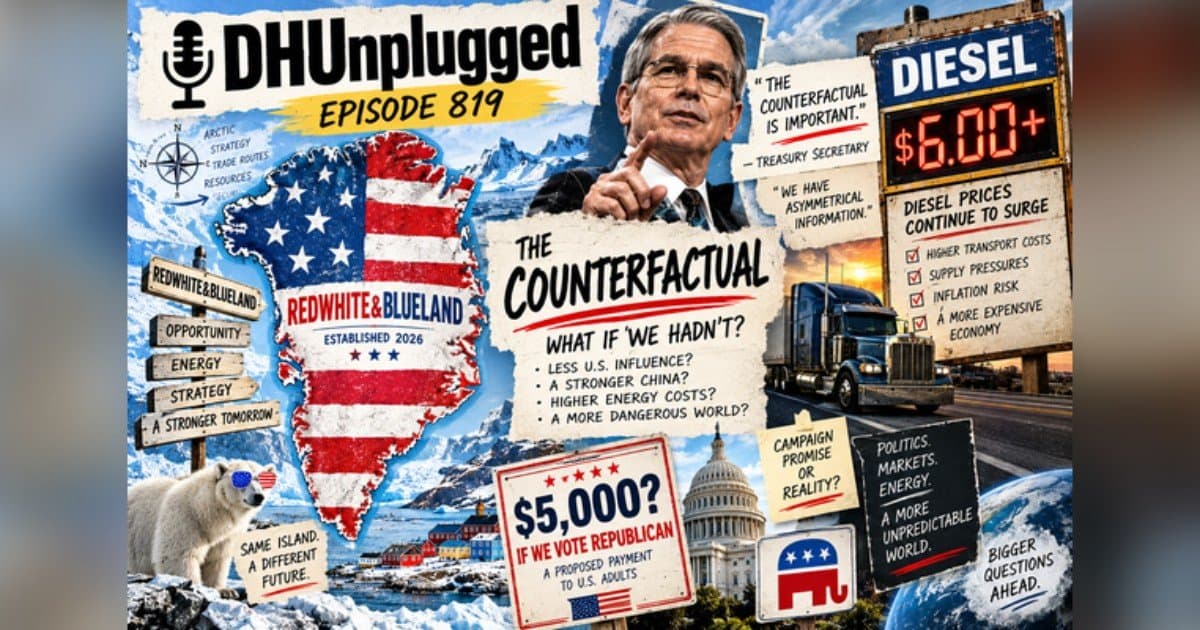
Treasury Secretary Scott Bessent's now-viral defense of the government's bond-buying program has ignited a debate over the use of unfalsifiable claims by public officials. On Episode 819 of the DH Unplugged podcast, titled "Counterfactualzzzz" and released September 23, 2026, hosts Andrew Horowitz and John C. Dvorak dissected Bessent's testimony from the September 15 House Financial Services Committee hearing, where he was questioned by Rep. Jim Himes about the 10-year Treasury yield hitting 5%.
Bessent's exchange with Himes included the line, "there's a counterfactual of what it would have done," a statement that Horowitz, a registered investment advisor, warned listeners against accepting. "By him saying it, he created a non-provable element... it dilutes the reality of what's going on so that you don't know what's happening," Horowitz said. Dvorak, drawing on his background in causal analysis, countered that legitimate counterfactuals require a control group, historical analog, or synthetic comparison, not simply asserting victory. The hosts' skepticism underscores a growing concern: when officials deploy unfalsifiable arguments, they undermine the public's ability to assess economic policy, potentially eroding trust in institutions and distorting market signals.
The episode also covered a range of market developments with implications for investors. It noted fresh NASDAQ 100 highs driven by a narrow band of names, a concentration risk that could leave the index vulnerable to sudden reversals. SoftBank and its CEO Masayoshi Son were highlighted for borrowing roughly $11 billion at junk-bond rates to fund ChatGPT-related investments, a move that raises questions about the sustainability of AI-driven debt financing. Additionally, Warren Buffett's decision to step down as Berkshire Hathaway chair, with Howard Buffett taking the seat and Greg Abel running operations, signals a major leadership transition at one of the world's most watched conglomerates.
On the regulatory front, Meta's Ray-Ban Luxottica smart glasses are facing a Paris prosecutor probe over covert filming, a development that could have broad implications for privacy and wearable technology. The hosts also delved into index construction, contrasting the market-cap-weighted S&P 500 with the equal-weighted RSP ETF and the price-weighted Dow Jones Industrial Average, where a single dollar move in Caterpillar translates to roughly seven Dow points. This technical discussion matters because it affects how investors interpret market performance and construct portfolios.
Horowitz revisited the hosts' long-running Generac (GNRC) seasonality trade, now transformed by data-center power demand, and named Seagate, Western Digital, and Micron among 2026's stealth outperformers. The pair also flagged Greenland-linked equities Greenland Minerals (GRML) and Critical Metals (CRML) surging on Trump's expanded Danish security deal, and questioned Bentley's $300,000 electric SUV as a Porsche-style luxury-to-premium downgrade. These insights offer listeners actionable intelligence on emerging trends and potential risks.
For business news readers, the episode serves as a reminder that policy rhetoric and market narratives must be scrutinized. Bessent's counterfactual defense, if left unchallenged, could set a precedent for avoiding accountability, affecting everything from interest rates to investor confidence. As Horowitz and Dvorak demonstrate, asking hard questions about official claims is essential for informed decision-making.
