

Business owners who once relied on noncompete agreements to keep key employees from leaving are rethinking that strategy, according to The McFarland Group (TMG), an Omaha-based advisory firm for owners of closely held businesses. The firm says companies are increasingly turning to well-designed equity compensation to retain and develop top talent.
The shift follows a series of regulatory changes. In 2024, the Federal Trade Commission issued a rule banning most noncompete agreements. A federal court set the rule aside that August. The FTC dropped its appeals in September 2025, and in February 2026 the rule was formally removed from federal regulations. The agency now challenges noncompetes case by case, and a growing number of states have restricted them on their own. As a result, owners can no longer count on a signed noncompete to prevent top talent from walking out the door or taking customers with them.
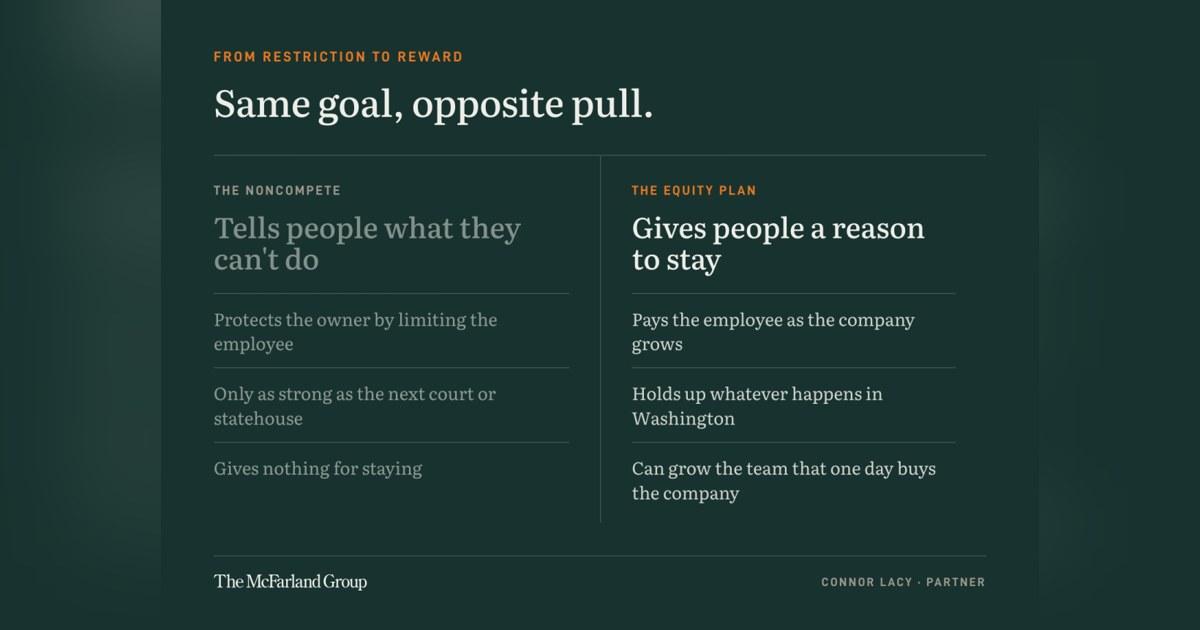
"For years, many owners treated the noncompete as their retention strategy," said Connor Lacy of The McFarland Group. "But a noncompete only tells an employee what they can't do. A well-built equity plan gives them a reason to stay."
TMG is seeing clients redesign incentive plans to do the work noncompetes once did. Common approaches include longer vesting schedules that reward employees for staying through key growth periods or an eventual ownership transition; deferred payouts tied to company value, so the largest rewards go to the people who help build it; clawback, nonsolicitation, and confidentiality terms paired with equity awards to protect customer relationships and confidential information; and performance-based vesting tied to measurable value drivers such as EBITDA growth and margin.
"The owners getting this right are using equity to build a management team that thinks like owners," Lacy said. "In many cases, that team can eventually become the buyer."
For business owners, the implications are significant. Employee departures can erode company value, and without enforceable noncompetes, owners need new tools to protect their most valuable asset: their people. TMG recommends that business owners review existing employment agreements and incentive plans with qualified legal counsel, identify the employees whose departure would most affect company value, and consider whether their current compensation gives those people a meaningful stake in the company's future.
"Regulation will keep changing," Lacy said. "A retention strategy built on shared value holds up whatever happens in Washington or the statehouse."
Lacy writes more about the four plan designs, and the team that can become the buyer, at themcfarlandgroup.com/blog/noncompetes-equity-plans-next-owners. The firm's guiding idea is simple: Go Boldly. Learn more at The McFarland Group.
