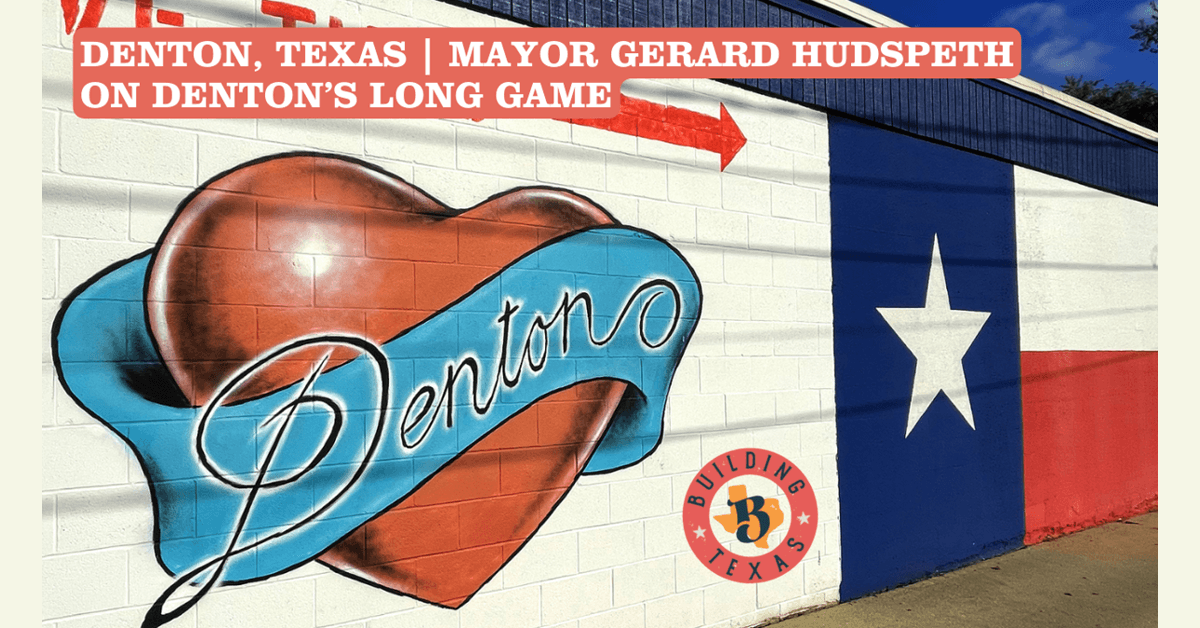
As growth accelerates across the Dallas-Fort Worth Metroplex, the City of Denton is pursuing intentional development strategies that balance expansion with community identity. Mayor Gerard Hudspeth, in a recent interview on The Building Texas Show, outlined how long-range planning, cultural investment, and regional collaboration are shaping Denton's future without sacrificing what makes the city distinctive.
Hudspeth, who was first elected to city council in 2017 and became mayor in 2020, emphasizes continuity in municipal leadership. "Cities don't change overnight," Hudspeth explained. "You pick up where your predecessors left off, stand on their shoulders, and keep moving the vision forward." His tenure has spanned significant challenges including the COVID-19 pandemic, Winter Storm Uri, rapid population growth, and shifting economic dynamics across North Texas.
Central to Denton's approach is balancing growth with livability. As home to major higher-education institutions including the University of North Texas and Texas Woman's University, Denton attracts students from across the state and beyond. The city faces the challenge of ensuring graduates can stay, work, and build lives locally. This requires focusing on job creation across logistics, advanced manufacturing, engineering, data infrastructure, and emerging technologies.
Major employers such as Peterbilt and Tetra Pak anchor the industrial base, while recent investments in high-speed computing infrastructure signal Denton's role in the next phase of digital and AI-driven industry. City leaders are actively working to attract higher-wage corporate and financial employers to broaden opportunity. "We want someone to graduate here, find a meaningful job, buy a home, and raise a family—without having to leave the city they love," Hudspeth said.
Denton's cultural ecosystem serves as both quality-of-life enhancement and economic strategy. From world-class music programs to a nationally recognized arts scene, cultural investments deliver measurable economic impact. The city's "31 Days of Halloween" celebration brought more than 830,000 visitors downtown over a single month, resulting in packed streets and thriving small businesses. "That's the visitor center, the chamber, economic development, and local businesses all pulling in the same direction," noted host Justin McKenzie during the conversation.
Looking ahead, Hudspeth highlights the Landmark Development—a 3,200-acre master-planned community in partnership with Hillwood—as a major milestone for Denton's next chapter. The project blends residential, retail, trails, and open space, anchored by H-E-B, and reflects years of planning around housing mix, workforce needs, and long-term sustainability. With more than 1,000 acres dedicated to trails and outdoor amenities, the development represents Denton's effort to grow thoughtfully while enhancing everyday life for residents. "It's about filling in gaps, not just adding rooftops," Hudspeth said. "Growth should make the city better, not just bigger."
Hudspeth underscores that municipal leadership is a service role built on collaboration, with mayors and council members working alongside professional city managers and staff. "Just because you can win an election doesn't mean you can run a city," Hudspeth reflected. "That's why strong partnerships and professional staff matter so much." For those interested in visiting, investing, or learning more, Hudspeth points to Discover Denton, the city's central hub for events, economic development resources, and community engagement.