

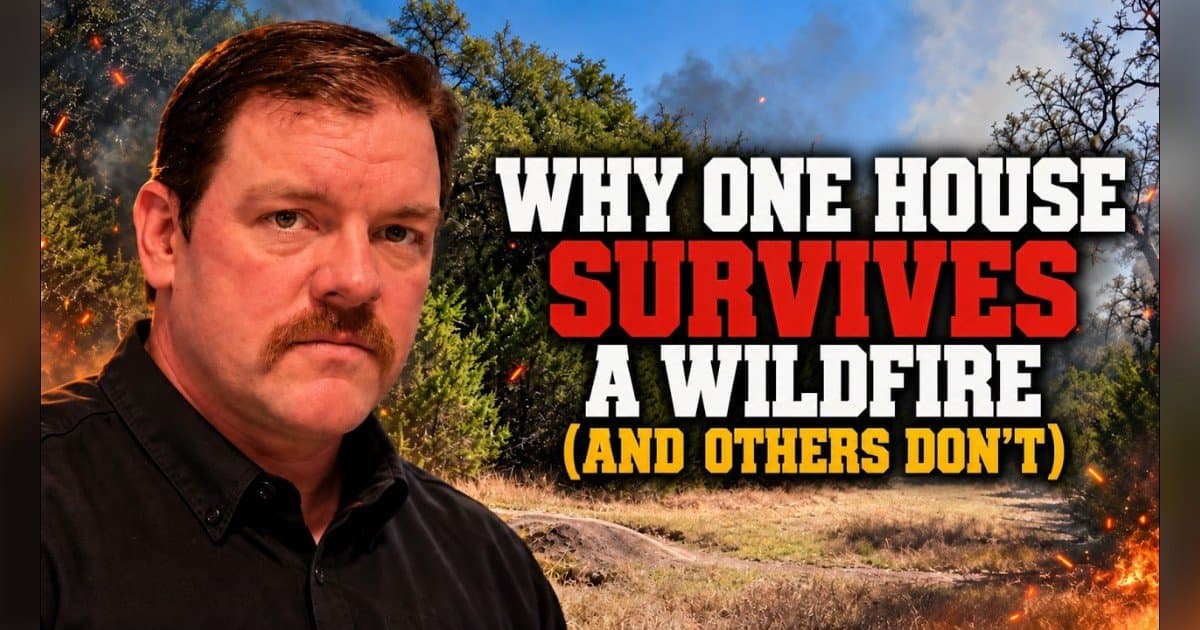
As large new homes push deeper into the Texas Hill Country's wildland urban interface, a working firefighter is offering a blunt, plain-English briefing on why some houses on a burning street survive while their neighbors do not. The September 30, 2026 installment of The Building Texas Show, hosted by Justin McKenzie, closes out the program's Sisterdale VFD series with that assessment in an episode titled "Why One House Survives a Wildfire (And the Rest Don't)".
The conversation moves through the mechanics and the mitigation behind wildfire risk. The firefighter explains why Ashe juniper, the native "mountain cedar," has overpopulated the Hill Country under a century of fire exclusion, and how grass fires become crown fires through "ladder fuels" loaded with oils and terpenes. He also addresses what the surviving homes in the Maui fires actually had in common, and why it was not wealth.
The guest is direct about the physics and the human failures behind modern wildfire disasters. "California builds whole subdivisions into box canyons in the wildland urban interface and then they're all surprised that the entire thing burns out when the forest fire comes," he tells McKenzie, before turning the same lens on Texas builders chasing picturesque ridgelines. On Maui's surviving houses, he pushes back on conspiracy theories: sometimes it is luck, sometimes it is the nature of wind shifts at the right times, but usually it is very simple, subtle things that made it very hard to burn.
Much of the episode is a practical field guide. The firefighter credits Christy Wiley as the driving force behind Kendall County's Community Wildfire Protection Plan (CWPP), which recently completed its 50th wildfire danger assessment survey and helped seed the new Hill Country Fire Coalition, working alongside Team Rubicon. He points listeners to newly revamped Texas A&M Forest Service materials on defensible space, the 0 to 5 foot and 5 to 20 foot zones around a structure, soffit and gable vent intakes, and Firewise planting guidance.
On residential sprinklers in new rural construction, he estimates the cost at 2 to 3 percent of new construction and calls it possibly the single highest-value upgrade a homeowner can make, noting that heat-activated heads fire individually, not all at once like in the movies. He also explains why week-old brush piles, not controlled burns, cause some of the county's worst fires. Listeners can hear the full episode via "Why One House Survives a Wildfire (And the Rest Don't)".
The Sisterdale Volunteer Fire Department will host its 49th Annual Hunters Supper & Firearms Raffle on Saturday, Nov. 14, 2026, from 5 to 9 p.m. at the William "Bill" Whitworth Fire Station, 1207 Sisterdale Rd., Boerne. Supper includes BBQ plates, a Cajun shrimp dinner and homemade desserts, and the raffle drawing is at 8:30 p.m. This year's featured prize is a 2026 Special Edition Custom Sisterdale VFD Henry 30-30 rifle, along with firearms, scopes, knives and more. Tickets are $10, winners don't need to be present, and firearm winners must complete the transfer through a licensed FFL. Proceeds support the gear, equipment and day-to-day needs that keep the station and its volunteers ready, including a new covered bay. Tickets and the full prize list are on the department's Hunters Supper & Raffle page.
The stakes extend beyond one county. As development accelerates across the Hill Country, the episode's central point is that survival often comes down to measurable choices, from defensible space to sprinklers, rather than luck or wealth, a message with direct implications for builders, homeowners and insurers in fire-prone regions.
