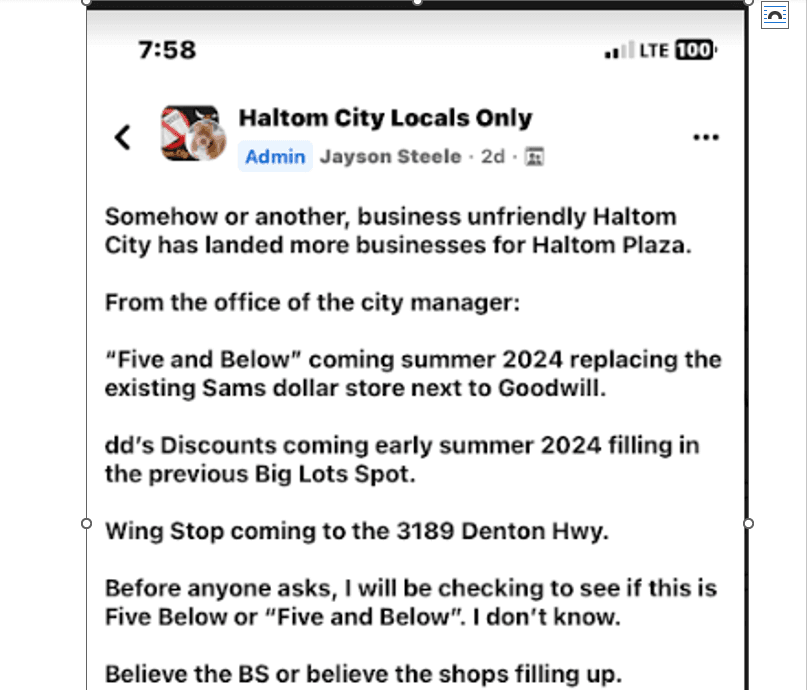
Haltom City, Texas, is grappling with the departure of several major businesses, raising concerns among local business advocates about the city's economic stability. According to a recent Facebook post by Jayson Steele, a Haltom City employee, Sam's Dollar Store and Big Lots have both ceased operations. These closures come at a time when new businesses like Five and Below and WD's Discount are set to replace the departed stores, and a new Wingstop is expected to open.
Joe Palmer, Communications Director for Haltom United Business Alliance (HUBA), emphasizes that while new businesses are coming in, the city still faces a critical issue. "Haltom City has lost two large businesses, replaced them with two new businesses, and added a third," Palmer said. However, he points out that the vacancy rate remains close to 30% and appears to be rising, particularly in the primary corridors. Most chain stores have already left the area.
HUBA believes that the older corridors in South and Central Haltom City will continue to decline unless the city takes concrete steps to repopulate these areas, primarily with small businesses. "The big businesses have left because of a lack of traffic and the continued decline of these areas in the south and central parts of the city," Palmer added.
Despite persistent calls for a revitalization plan, including a proposed list of improvements to city codes to encourage new businesses, Haltom City's council and leadership have yet to propose any concrete measures. Palmer noted that newly elected council members have shown enthusiasm for improvements on the north side of the city but have remained silent on plans to revitalize the southern and central areas.
The city maintains that recent developments and new businesses on the north side are indicators of a thriving business environment. However, the deteriorating conditions in the south and central parts of Haltom City are evident to residents and potential new citizens. A recent report indicates that Haltom City's population is declining, even as the Dallas-Fort Worth area sees an influx of 1,000 new residents daily. Other cities in Tarrant County are experiencing growth, but Haltom City is not.
HUBA continues to advocate for public hearings and the proposal of plans to improve the city's declining areas. This situation is not unique to Haltom City; many smaller, older cities across America face similar issues, including increased crime and a loss of businesses in their central districts. A simple Google search reveals numerous success stories of cities that have implemented urban renewal strategies to reverse such trends.
In summary, Haltom City is at a crossroads. While new businesses are moving in, the high vacancy rate and declining population in its central and southern areas are cause for concern. HUBA's call for a comprehensive revitalization plan aims to address these issues and revitalize the city's economic landscape.