

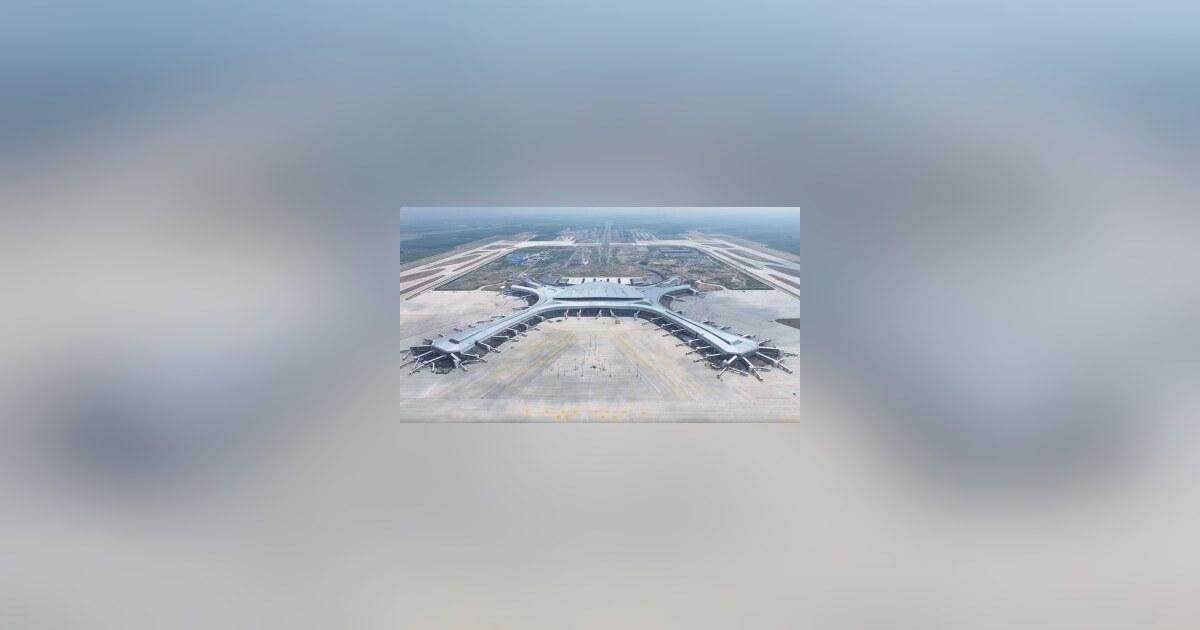
Hohhot Shengle International Airport will officially begin operations on November 26, becoming the Inner Mongolia Autonomous Region's first 4F-class international airport. The new facility replaces Baita International Airport, which has served the region for 68 years, and represents a major increase in the capacity of Inner Mongolia's air links with the outside world, according to an announcement carried by Media OutReach Newswire.
The airport is designed to handle 28 million passengers, 320,000 tonnes of cargo and mail, and 244,000 aircraft movements annually. It features a terminal building of 320,000 square metres, two widely spaced parallel runways 2,000 metres apart that can operate independently, and an apron with 130 aircraft stands. In March 2026, the airport's port-of-entry facilities passed the autonomous region's acceptance inspection, with customs, immigration and other inspection facilities fully in place to meet international operations requirements.
The importance of the opening lies in the capacity constraints at Baita. That airport opened in 1958 with an original capacity plan envisaging 3 million passengers annually by 2015, but traffic has long exceeded that limit as Hohhot's economy and cultural tourism sector have grown. Shengle is positioned to resolve the regional capital's aviation capacity bottleneck and mark a new stage in the development of Inner Mongolia's modern integrated transport network.
Beyond passenger capacity, Shengle is designated as a regional aviation hub, one of the main alternate airports for the Beijing–Tianjin–Hebei airport cluster, a national Class I air port of entry, and an important transport node for the Belt and Road Initiative. The departures hall includes clearly defined areas for international departures, departures to Hong Kong, Macao and Taiwan, and international check-in islands, with bilingual Chinese–English signage to help passengers navigate their journeys.
Ahead of the transfer, Hohhot already operates six regular international passenger routes: to Ulaanbaatar in Mongolia; Seoul, Daegu and Busan in South Korea; Vladivostok in Russia; and Bangkok in Thailand via Chongqing. The Ulaanbaatar service is Inner Mongolia's most frequent direct air link between China and Mongolia. From January to July this year, Baita handled 997 inbound and outbound cross-border flights, up 69.9% year on year, and 69,200 cross-border passengers, up 89.3%, reflecting increasingly active cross-border exchanges and cooperation in culture and tourism.
Once Shengle opens, the entire existing route network will transfer to the new airport. Inner Mongolia will use the hub's wider reach to steadily expand international routes to Russia and Mongolia, increase flight frequencies to key domestic regions including the Yangtze River Delta, Guangdong–Hong Kong–Macao, and Chengdu–Chongqing, and improve its network of regional feeder services. Air and overland links will complement each other: Hohhot has launched 22 international transport routes, while its China–Europe and China–Central Asia freight train services reach more than 70 stations in over 10 countries across Europe and Asia.
The new airport's reach will extend well beyond a single city or locality, connecting with the air networks of China's key economic regions, Northeast Asia and the Russian Far East, while feeder routes will link the grasslands with border ports of entry. It will also connect with platforms for international trade and cooperation, including pilot free trade zones, China–Europe freight train services and cross-border e-commerce.
