

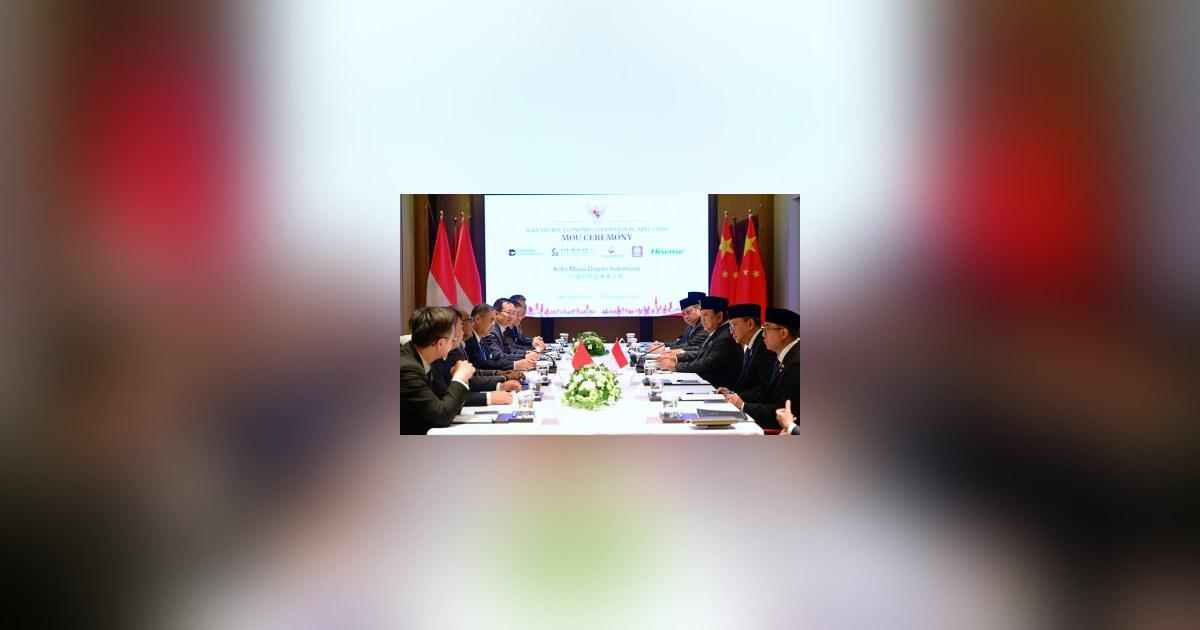
Indonesian and Chinese companies and institutions set out four areas of cooperation with a combined indicative value of USD 63 billion during APEC Economic Leaders' Week in Shenzhen, according to Media OutReach Newswire. President Prabowo Subianto witnessed the signing of memoranda of understanding on smart cities, home-appliance manufacturing and technology, and coal-to-ethanol fuel production. Separately, three Chinese financial institutions discussed a proposed renminbi financing framework of up to USD 10 billion equivalent with PT Danantara Asset Management.
The initiatives bring Chinese capital, engineering, and process technology to priorities the Indonesian government has set for this decade: housing, industrial capacity, energy independence, and supporting infrastructure. The Chinese parties described their participation as an expression of confidence in Indonesia's economy and the direction of its government.
The largest component is a smart-city programme valued at USD 50 billion. PT Kota Masa Depan Indonesia, a project entity 99% owned by PT Danantara Asset Management, signed a non-binding memorandum with a consortium led by Shaanxi Construction Engineering Group, including Hisense and other Chinese companies. The plan envisages 10 cities at an indicative USD 5 billion each, with approximately 1.5 million housing units and supporting infrastructure for about 3 million residents. Each city is planned as a set of complete neighbourhoods with schools, hospitals, places of worship, markets, parks, and municipal service centres, alongside utilities and digital systems such as water treatment, wastewater networks, flood protection, waste recycling, solar power distribution, fibre networks, and command centres that monitor traffic and utilities. The consortium expects to deliver over the next three to five years, subject to procurement processes.
Infrastructure financing could add up to USD 10 billion equivalent in renminbi. Changjiang Securities International, Shanghai Pudong Development Bank Hong Kong Branch, and SDIC Securities (Hong Kong) held a constructive exchange with PT Danantara Asset Management on 17 November 2026. The proposed framework would be assembled in two parts: USD 5 billion equivalent through panda bonds in mainland China's interbank market and USD 5 billion equivalent through dim sum bonds in Hong Kong. Funds would be deployed in stages following each project's construction and drawdown profile. Target sectors include power generation and grid modernisation; renewable energy, storage, and transmission; downstream mineral processing and industrial estates; advanced manufacturing; digital infrastructure and data centres; transport and logistics; and healthcare. The framework can also apply to the smart-city programme, so up to USD 10 billion of the total may overlap. The institutions' participation does not indicate irrevocable commitment of funds.
In coal-to-ethanol, Beijing Petrochemical Engineering signed a memorandum with Badan Industri Mineral, the Agency for Mineral Industry, valued at USD 2 billion. The cooperation aims to convert Indonesia's low-grade coal into ethanol for transport fuel, with production and refining based in Indonesia for the domestic market. Producing ethanol at home would reduce dependence on imported fuel, add value to a resource Indonesia holds in abundance, create skilled industrial jobs, and keep more energy spending inside the economy. BPE holds multiple patents across process technologies, including coal-based ethanol technology developed jointly with the Dalian Institute of Chemical Physics, Chinese Academy of Sciences.
Hisense signed a memorandum advancing its investment programme in Indonesia, with an indicative value of USD 1 billion. The company plans to establish its largest home-appliance manufacturing facility outside China, serving the domestic market and exports, with scale, site, and timeline to be defined. Hisense will increase manufacturing investment in step with demand from Indonesia's Koperasi Merah Putih programme, under which the government plans around 80,000 village and urban cooperatives to shorten distribution chains for essential goods. Hisense and Institut Teknologi Bandung are also establishing a laboratory, funded by Hisense, to support Indonesia's household transition from gas to electricity and to develop energy-efficient appliances suited to Indonesian homes. In 2025, Hisense supplied interactive teaching displays to nearly 300,000 classrooms across more than 6,000 islands under Indonesia's national education programme.
The announcements align with APEC's digital and artificial intelligence ministers' agreement to promote AI-enabled urban governance, better digital infrastructure, and digital inclusion across urban and rural areas. For readers and investors, the deals signal deeper Chinese engagement in Indonesia's long-term development, with potential implications for infrastructure, manufacturing, energy, and digital sectors across the region.
