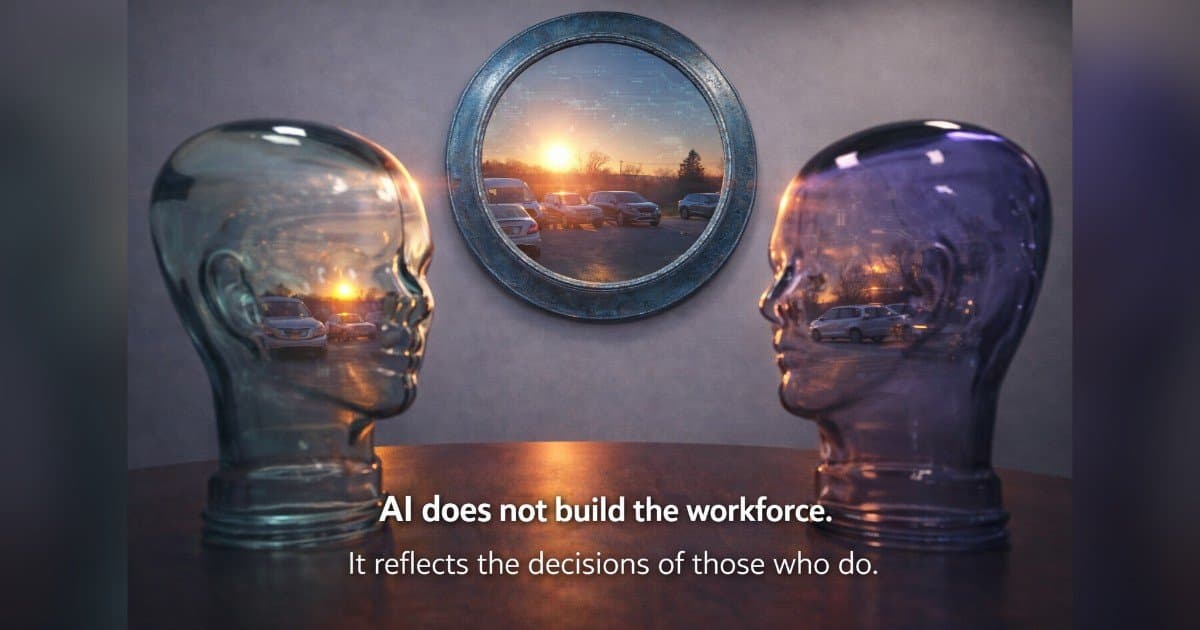
The integration of artificial intelligence into industrial environments has sparked widespread discussion about workforce displacement, but industry experts emphasize that AI functions as a tool whose value depends on human cognition, contextual judgment, and domain-specific expertise. This perspective shifts the conversation from replacement to collaboration, highlighting how Industrial STEM education prepares leaders and skilled professionals who can interpret data, apply technology effectively, and build workforce pipelines for emerging industries.
Industrial STEM represents more than a combination of technical disciplines; it integrates scientific knowledge with applied industrial practice, real-world mechanics, constraints, and problem-solving required to transform theory into production. The distinction becomes clear when considering how data functions versus why data matters in manufacturing environments. While a data analyst might recognize anomaly patterns, a machinist or maintenance technician understands whether that anomaly represents tool wear, material inconsistency, operator variation, or environmental influence. Without industrial context, data remains incomplete, and AI, regardless of sophistication, relies on domain-specific understanding to produce meaningful outcomes.
The evolution of industrial measurement illustrates this interdependence. For decades, industries have measured cycle times, defects, uptime, productivity, efficiency, and quality. What has changed is the speed and scale of measurement, with predictive and preventive models now allowing anticipation of challenges before they occur. However, predictive capability introduces new demands for interpretation, as predictions only become valuable when professionals understand how to act upon them. Industrial professionals serve as translators between AI outputs and operational reality, determining whether recommendations align with safety regulations, production deadlines, workforce capabilities, and real-world constraints.
This interpretive function represents a new layer of leadership in industrial environments. Leaders must now understand both technology and human systems, asking whether recommendations align with operational realities, if they solve the right problems, what downstream consequences might emerge, and how to help workers trust AI-driven insights. AI cannot answer these questions; only humans grounded in experience, ethics, and contextual understanding can make these judgments. The future workforce requires professionals who can think critically within industrial environments and maximize available tools, which forms the foundation of Industrial STEM education.
The narrative that AI will replace workers oversimplifies industrial reality. Historical patterns show technological advancements typically transform rather than eliminate work, requiring new skills, thinking, and leadership approaches. In industrial sectors, AI increases demand for workers possessing technical literacy, systems thinking, applied problem-solving, interdisciplinary understanding, and context-grounded decision-making. The worker of the future becomes empowered rather than replaced by AI, provided they receive proper preparation. The real risk lies not in AI replacing humans but in failing to prepare humans to use AI effectively, as discussed in Dr. Johnson's article on Workforce Education.
Educational institutions, industry leaders, and workforce development partners face a critical decision: whether to train individuals to use technology or develop thinkers who understand how technology fits within real industrial systems. The distinction proves significant, as teaching software use alone creates operators while teaching industrial science, application, and mechanics creates leaders. As AI expands, industrial experience gains rather than loses value, with the ability to connect data to physical processes becoming a competitive advantage. Industrial STEM focuses not on competing with AI but empowering humans to direct it.
The future of industry will be defined by collaboration between human cognition and intelligent tools, creating environments where AI monitors equipment health while skilled professionals interpret recommendations, leaders balance efficiency with safety and quality, and workers leverage data to enhance craftsmanship. This human-centered industrial intelligence depends on one non-automatable factor: human understanding. As industrial systems advance, industries that recognize AI as a tool rather than the workforce will thrive, with human cognition remaining the anchor that gives meaning to information. Industrial STEM becomes indispensable in the age of AI because progress begins with questions, decisions, and humans willing to think.