

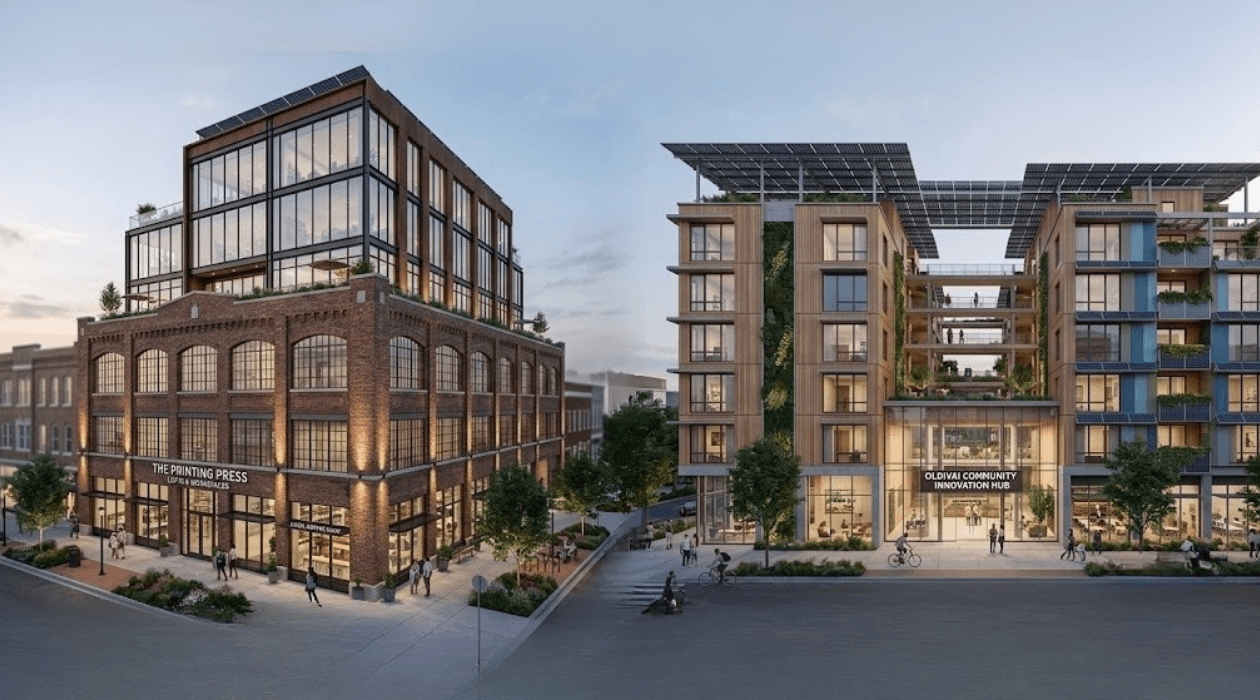
Kaufman Real Estate & Consulting, with development partner Oldivai, announced a two-site redevelopment in Jacksonville's Springfield Historic District that pairs adaptive reuse of a century-old industrial building with new modular workforce housing across the street. The project aims to address the city's need for attainable housing while preserving the neighborhood's historic character.
The plan involves restoring a two-story brick building at the northwest corner of Main and 12th streets, once home to Screen Process Printers Inc., and adding three new stories to create a five-story, 125,000-square-foot mixed-use building. The structure will include ground-floor retail and workspace, rooftop terraces, 80 residential loft units, and 50 workspace suites. The adaptive reuse investment is estimated at $40 million, with a delivery timeline of 24 to 30 months.
Directly across West 12th Street, on a 0.23-acre parcel at 2124 N. Main St., Oldivai will develop a 150-unit workforce housing community using an iteration of its Project Zero model. This modular, kit-of-parts construction method involves building modules off-site in a climate-controlled factory using LEAN/Six Sigma manufacturing, then delivering and setting them in place by crane. The workforce housing project is estimated to cost $35 million and is expected to be delivered in 16 to 20 months.
The workforce housing will target the "missing middle" — teachers, healthcare workers, first responders, and tradespeople earning approximately 80–120% of area median income. These essential workers often cannot afford housing in the neighborhoods they serve. The modular approach accelerates development and improves quality and cost control relative to conventional construction.
The combined sites were acquired in October 2019 by Springfield Community Development LLC, an entity managed by Daniel Kaufman, for $515,000. The location is in the Springfield Warehouse District, adjacent to Andrew A. Robinson Elementary School, within one of the largest historic districts in the southeastern United States.
Daniel Kaufman, President of Kaufman Real Estate & Consulting, said, "Springfield is one of the best examples in the country of what adaptive reuse can do for a neighborhood. We've owned this corner since 2019 because we believed it deserved a plan that respected its history instead of erasing it. Restoring the building and building workforce housing across the street lets us do both at once."
Susan Gillespie, Chief Operating Officer of Oldivai, added, "Project Zero proved that modular construction can deliver workforce housing faster and at higher quality than the conventional process allows. Jacksonville gives us the chance to bring that model to a neighborhood with real employment density and real need for attainable housing."
This redevelopment exemplifies a growing trend in urban planning: combining historic preservation with innovative construction to address housing shortages. By adding density without sacrificing heritage, the project could serve as a model for other historic districts facing similar pressures.
The project aligns with broader efforts to meet the demand for housing in Jacksonville, where rising rents and limited supply have made it difficult for middle-income earners to find affordable options. The introduction of modular workforce housing is expected to provide quality, cost-effective homes more quickly than traditional methods.
As the project progresses, it will be closely watched by developers and urban planners for its potential to replicate the success of Oldivai's Project Zero in Spokane, Washington. The use of cross-laminated timber (CLT) and net-zero-ready designs also underscores a commitment to sustainability, which could influence future developments in the region.
