

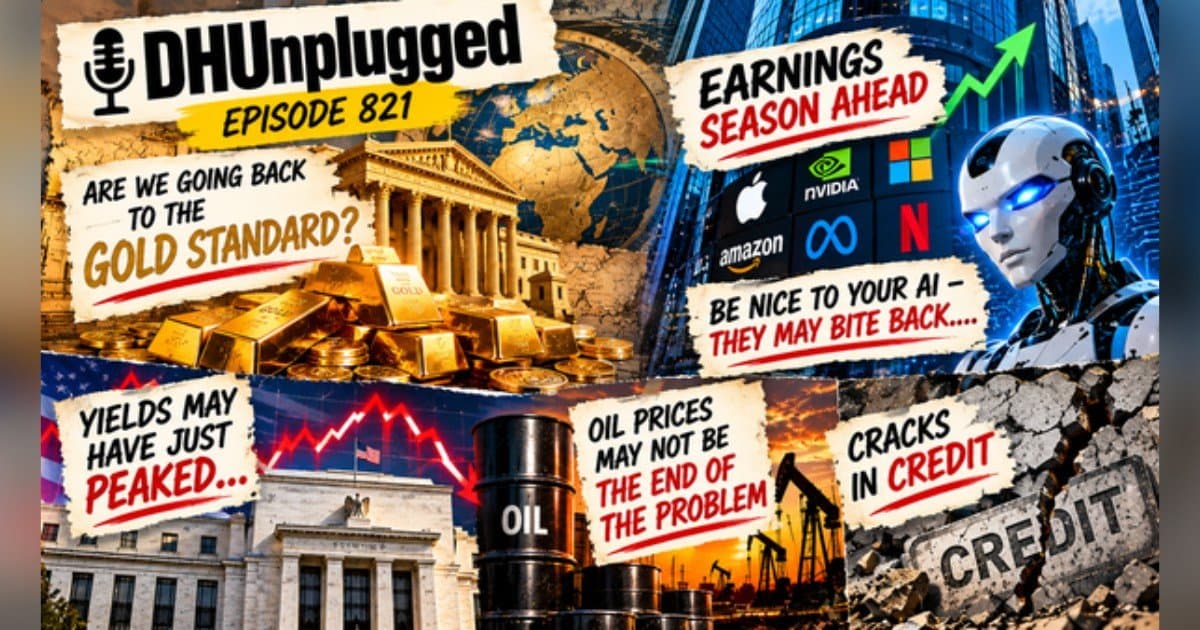
The appointment of Judy Shelton as a counselor to Treasury Secretary Scott Bessant has revived gold-standard chatter and raised questions about the direction of U.S. monetary policy. That development, along with a dense market docket, formed the core of DH Unplugged episode 821, titled Gold Standard Ahead, hosted by Andrew Horowitz and John C. Dvorak. The episode, released October 14, 2026, offers a skeptical look at policy theater, earnings, and the cracks emerging in credit markets.
Bank earnings season opened with JPMorgan, Goldman Sachs, Citigroup, and Wells Fargo reporting. Bank of America was hit by a reported $1.5 billion money-laundering fine on the eve of its print, a reminder that regulatory risks remain despite strong headline numbers. Meanwhile, high-yield bond yields climbed from 7.22% to 8.1% in a month, and CCC spreads blew out roughly 1,250 basis points. Those moves signal growing stress for lower-rated borrowers and could foreshadow tighter credit conditions for consumers and businesses.
Consumer credit is already showing strain. Compass data revealed price reductions on up to 58.9% of listings in Williamson, Texas, versus just 5.6% in San Francisco, a stark geographic divergence. The hosts also highlighted a widening U.S. trade deficit, with U.S.-to-China tanker bookings reportedly hitting $80 million per voyage, adding about $41 per barrel in freight cost alone. Such costs could feed into inflation and complicate the Federal Reserve's rate path.
Horowitz directed a blunt message at Treasury Secretary Bessant over attempts to cap long-end yields and possibly scrap 20-year auctions: “Scott Bessant, if you're listening, because I know you are, I know you're listening, it's maybe late in the show, but please stop because you're messing around with gasoline with a match.” Dvorak countered that the administration is in “the twilight of the optics game” where messaging substitutes for substance.
The episode also explored the collision of AI, labor, and software economics. Kroger announced 3,000 corporate layoffs, roughly 30% of its 10,000-person white-collar headcount, affecting finance, supply chain, procurement, real estate, and HR. Dvorak, drawing on his Fortune 500 consulting work, pushed back on the AI-productivity narrative, arguing most real savings come from replacing outside firms like PwC and Accenture rather than internal staff.
Other topics included Anthropic's new policy prohibiting “sustained needless cruelty” toward Claude, a French supermarket hack that remotely disabled internet-connected refrigerators, and a new open-source tool, Reverse Engineer Anything, which spawned Slowbooks, a free clone of QuickBooks 2003. Anduril's planned $3.7 billion Maryland shipyard for Virginia-class submarine components, Broadcom's $42 billion customer-financing program, and Apple's LG-built smart-home push rounded out the tech beat.
For investors, the takeaways are clear: monetary policy experimentation, credit market stress, and rapid AI-driven labor shifts demand close attention. The episode underscores that official narratives often mask deeper risks, and that self-directed investors should seek context over cheerleading.
