

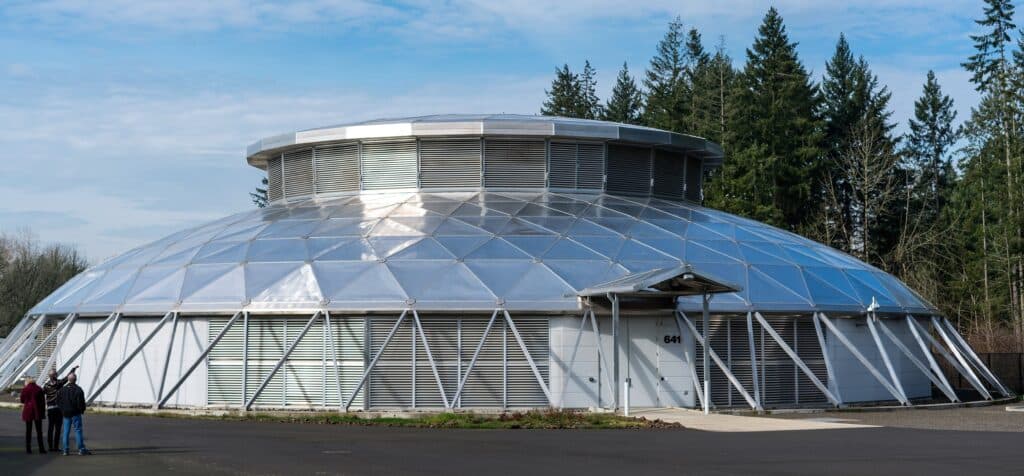
Kaufman & Company, the Los Angeles-based private investment and holding firm founded by Daniel Kaufman, has started construction on two hyperscale data center projects in Utah and Texas, utilizing a proprietary geodesic dome design. The facilities, located near Salt Lake City, Utah, and in El Paso, Texas, mark the company's entry into large-scale AI infrastructure.
The dome structure is engineered specifically for AI workloads. Its curved, column-free interior creates natural convection, reducing the need for traditional chiller plants. A hybrid air and direct liquid immersion cooling system cuts water use by roughly 90 percent compared with conventional data centers. The geodesic shape also requires about 30 percent less structural material than a standard rectangular shell, according to the company.
Facilities can scale in increments from 10 to 20 megawatts up to 50 to 100 megawatts and can be brought online in as little as 12 months, compared with the multi-year substation queues typical of hyperscale builds. “The issues of power, water, appearance and jobs are real, impactful concerns, and we were seeing them in our own projects and across the industry,” said Daniel Kaufman, founder of Kaufman & Company. “The geometry is what makes this exciting. It is a dome with a green roof that blends into the landscape rather than another lit box stretching for miles.”
Each dome draws up to 90 percent of its power from behind-the-meter sources rather than the grid. In Utah, that power comes from rooftop solar; in El Paso, the company is also developing its own geothermal generation, producing enough capacity to supply outside users in addition to the facility itself. The green roof also collects water used for cooling, meeting an estimated 90 percent of each site's cooling needs.
The El Paso project sits on roughly 24,000 acres of formerly idle ranch and oil and gas land near the U.S. border. Phase one already has tenants secured, and Kaufman & Company expects to build as many as ten additional domes on the site over the next decade. The company is in early conversations to bring the same model to Louisiana, Oklahoma, North and South Dakota, as well as international markets including India, Europe, and Canada.
“In Utah, the community saw the server dome, and it changed the whole conversation,” Kaufman said. “Drive through that area, and you see traditional data centers that are just big boxes. This is not blight, it is something we hope will be beautiful.”
Given the scale of hyperscale data center development, which runs beyond Kaufman & Company's typical self-funded model, the company has brought in outside capital and infrastructure partners for the first time, including Meta, Google, Oracle, Microsoft, AT&T, Zayo, Fiberlight, Aurelia and Firmica, along with institutional lenders and government agencies.
Kaufman has named Ryan Wallace to lead the company's data center initiative, supported by a team including Bruce Brady, Chris Piggott, Ken Dowers, David Cooper, Boji, senior advisor Bill Winieski, and resiliency specialist Sharon McPherson. The move allows Kaufman to shift his focus to other projects. Kaufman & Company is pursuing LEED Platinum certification for the server dome facilities.
