

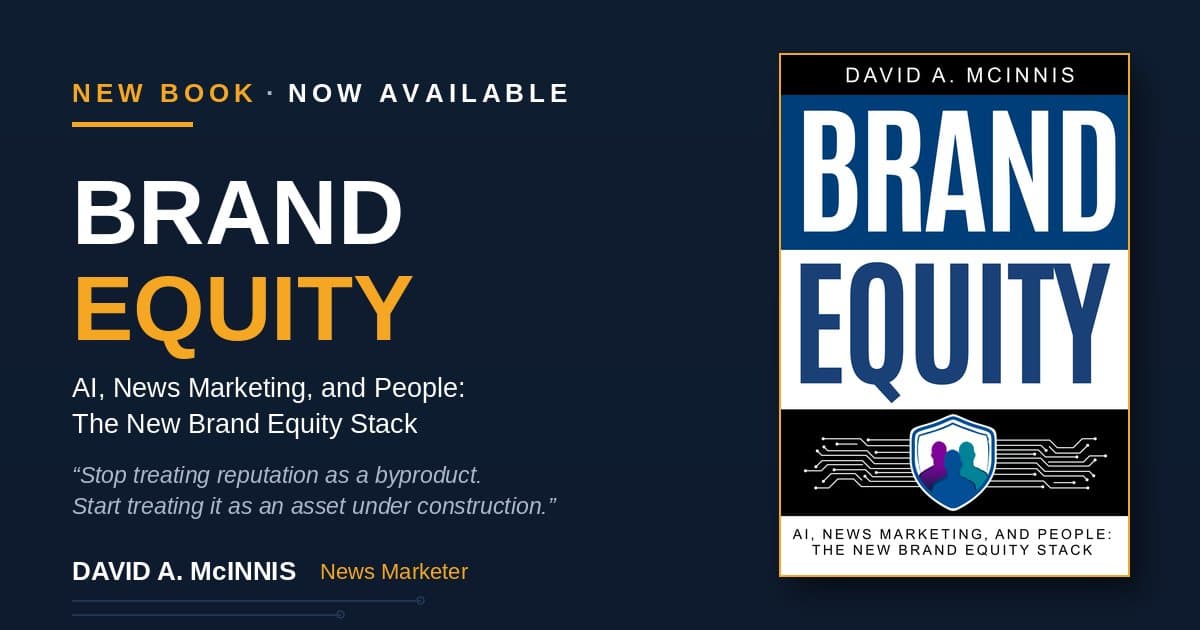
David A. McInnis, the founder of PRWeb and a pioneer of News Marketing, has released a new book titled 'Brand Equity: AI, News Marketing, and People: The New Brand Equity Stack.' The book, the second in a series that began with 'News Marketing,' argues that brand equity is no longer solely what people remember but also what retrieval systems can find, trust, and reuse when someone asks a question in your category.
McInnis defines brand equity as the accumulated trust, recognition, and preference that lives in other people's heads, and the commercial advantage that stored-up goodwill creates: higher prices, faster conversion, cheaper marketing, stronger talent and press, resilience after mistakes, and a higher exit value. He notes that for decades, this asset felt reserved for companies with television budgets and research firms on retainer. But the landscape of distribution, measurement, and discovery has transformed, allowing small and mid-sized businesses to build equity on purpose without an eight-figure media buy.
The book's central frame is what McInnis calls the new brand equity stack: AI, News Marketing, and people. AI accelerates research, drafting, and multi-format work. People and culture make the brand true at the point of contact. News Marketing is the credibility and findability engine in the middle. 'AI makes the process faster. News Marketing makes it credible. People make it believable. Measurement makes it honest,' McInnis writes. 'Preference is the point of brand equity. Generic sludge does not create preference.'
McInnis, who has spent over three decades building tools for small businesses, outlines how News Marketing accomplishes five critical tasks for brand equity simultaneously: third-party validation, familiarity through repetition, authority signals, a living public newsroom, and durable retrieval assets that ensure AI systems deliver accurate answers. 'Advertising buys attention,' McInnis writes. 'News Marketing banks proof.'
The book's practical sections delve into the anatomy of brand equity, including awareness, associations, perceived quality, loyalty, and findability. It includes a monthly Brand Equity Dashboard utilizing free and low-cost signals, as well as strategies on pillar development, social proof, consistency, culture, and a comprehensive twelve-month plan. Three chapters walk through News Marketing in full: how to write and cadence press releases, how to turn one release into an AI-optimized multi-format package, and how to read modern newswire reporting without fantasy metrics.
McInnis clearly states what AI cannot achieve. It will not choose pillars, attend customer calls, decide what is newsworthy, or earn the third-party validation that makes a claim believable. Tools amplify strategy, but they do not replace it. 'Brand equity is not magic, not luck, and not the exclusive property of companies with famous logos,' McInnis says. 'It is the predictable output of a repeatable process: deliberate visibility, in consistent themes, validated by third parties, structured for retrieval, measured continuously.'
The book is written for operators who want a field manual, not a prompt cookbook. It is available now as a free download for a limited time and for purchase on Amazon.com. Laura Sturaitis, EVP (Retired) Business Wire, praised McInnis's work, noting that he has 'literally written the book(s) revealing the tried and true marketing methods and strategies that have delivered for top-tier companies, organizations and leading brands.'
McInnis's previous book, 'News Marketing,' is the first in the series, and 'Success Pillars' will be the third. Each book stands alone, but McInnis returns to News Marketing because it is how he has practiced visibility for nearly thirty years: put news on the open web in a structured, timestamped, entity-clear form; treat the press release as a seed, not a fax to a gatekeeper; then amplify the same true story across formats so customers, journalists, search engines, and AI systems can find it.
