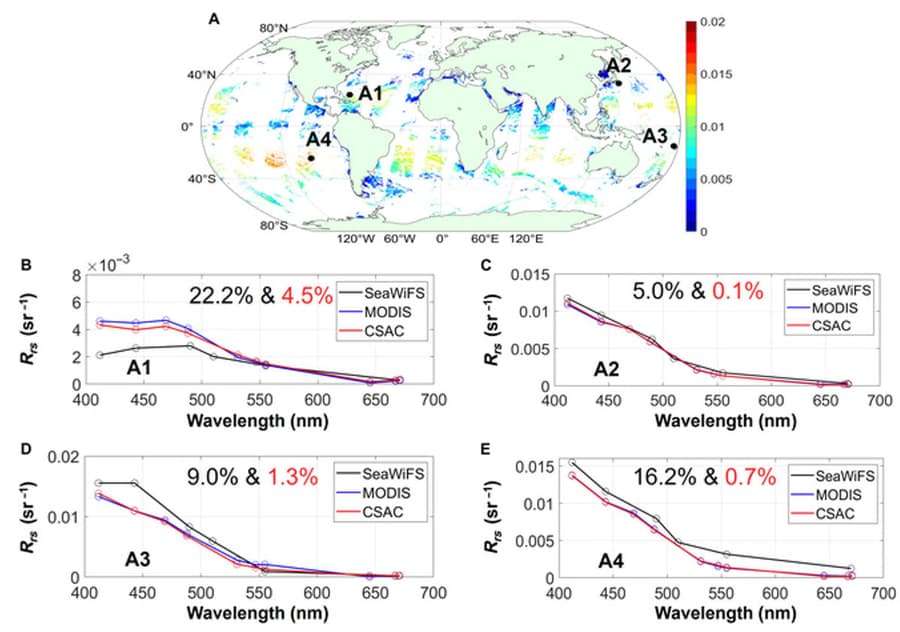
A team of scientists has unveiled a revolutionary method that could transform our understanding of the world's oceans and their role in climate change. The Cross-Satellite Atmospheric Correction (CSAC) system, developed by researchers from the State Key Laboratory of Marine Environmental Science at Xiamen University and the National Satellite Ocean Application Service, promises to resolve long-standing inconsistencies in satellite ocean color data.
The CSAC system, detailed in a study published in the Journal of Remote Sensing, uses artificial intelligence to align top-of-atmosphere reflectance data from various satellites with high-quality data from MODIS-Aqua. This innovative approach has successfully reduced discrepancies in remote sensing reflectance (Rrs) across different wavelengths by up to 50% compared to traditional methods.
Dr. Zhongping Lee, a lead researcher on the study, emphasized the significance of this advancement: 'The CSAC system represents a significant advancement in satellite ocean color remote sensing. By harnessing decades of the highest-quality MODIS-Aqua data and sophisticated machine-learning techniques, we have resolved critical inconsistencies in Rrs among different satellites.'
The implications of this breakthrough are far-reaching. By ensuring consistency in satellite-derived bio-optical data, scientists can now produce reliable, long-term data products from multiple satellite missions. These datasets are crucial for observing shifts in ocean ecosystems, examining the ocean's role in the carbon cycle, and evaluating the impacts of climate change on marine environments.
The development of CSAC marks a significant shift in satellite data processing, transitioning from radiative-transfer-based approaches to more advanced data-based systems. This evolution in methodology opens new possibilities for comprehensive, global-scale monitoring of the upper ocean, providing vital information for climate studies and environmental assessments.
As climate change continues to affect marine ecosystems worldwide, the ability to generate accurate, long-term records of ocean bio-optical properties becomes increasingly important. The CSAC system's capacity to harmonize data from various satellite missions, including SeaWiFS and MERIS, will enable researchers to create more comprehensive and reliable datasets spanning multiple decades.
This advancement in ocean monitoring technology comes at a critical time when understanding the complex interactions between oceans and climate is more crucial than ever. The improved data consistency and accuracy provided by CSAC will empower scientists, policymakers, and environmental agencies to make more informed decisions regarding ocean conservation and climate change mitigation strategies.