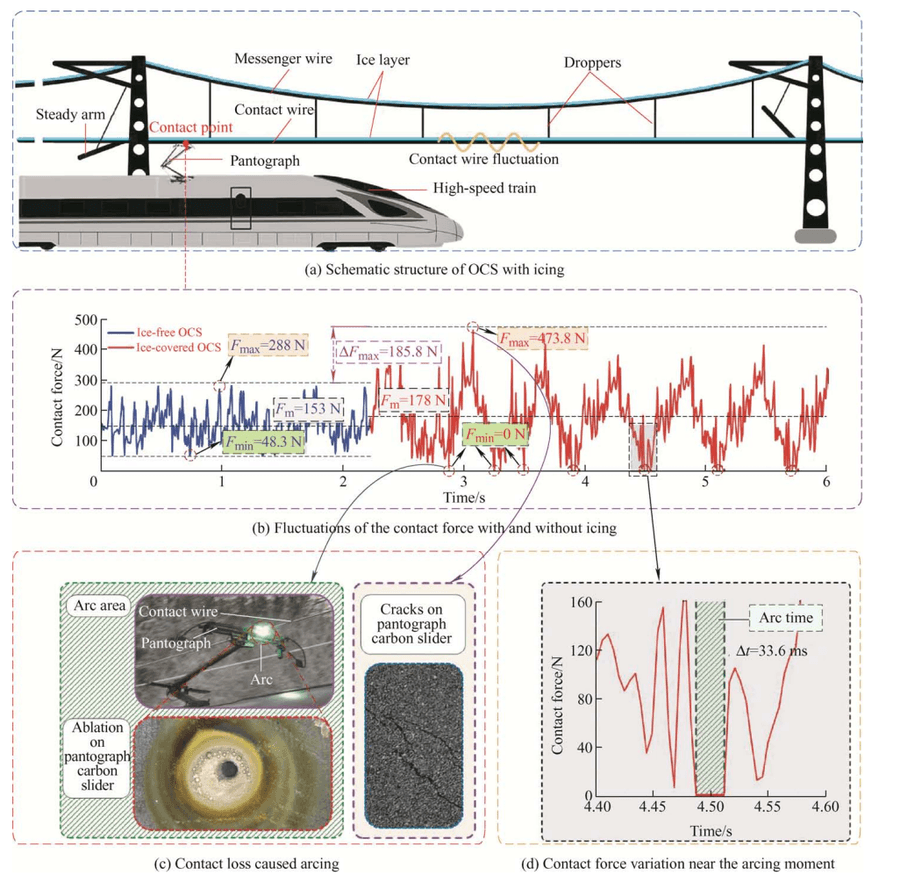
A recent study assesses the adaptability of overhead contact systems (OCS) in high-speed railways under icy conditions, presenting a new approach to ensure safe and continuous electrical energy collection. This research, conducted by experts from Southwest Jiaotong University and the National Rail Transit Electrification and Automation Engineering Technology Research Center, introduces a dynamic model to simulate the pantograph-catenary system's (PCS) performance under different icing scenarios.
Icy conditions pose significant challenges for high-speed railways, leading to increased fluctuations in contact force and a higher incidence of arcing, which undermine both safety and service reliability. The study aims to address these issues by providing an in-depth analysis of how OCS systems perform in such environments.
The researchers' findings, published in the Chinese Journal of Electrical Engineering, offer a comprehensive framework for evaluating OCS resilience. The dynamic simulation captures critical metrics such as contact force and arcing propensity, revealing system equilibrium and dependability. One of the study's key innovations is the introduction of the OCS sensitivity coefficient, a quantifiable indicator of environmental responsiveness.
According to Dr. Guangning Wu, an IEEE Fellow, this research has transformative potential for high-speed rail maintenance. "The advent of the OCS sensitivity coefficient is a quantum leap, providing us with precise standards for assessing the environmental impact of railway systems," he stated. "This work is set to redefine the fortitude of overhead contact systems in climes of extremity."
The implications of this research are far-reaching. By identifying the most robust OCS structures and understanding their environmental sensitivity, railway operators can implement precise enhancements to fortify the operational integrity of high-speed rail. This proactive approach not only ensures reliable service but also minimizes economic disruptions caused by service standstills.
The study, supported by China State Railway Group Co., Ltd., Chengdu Guojia Electrical Engineering Co., Ltd., and the Natural Science Foundation of Sichuan Province, is poised to influence the blueprint and upkeep of railway infrastructure, particularly in icy climates.