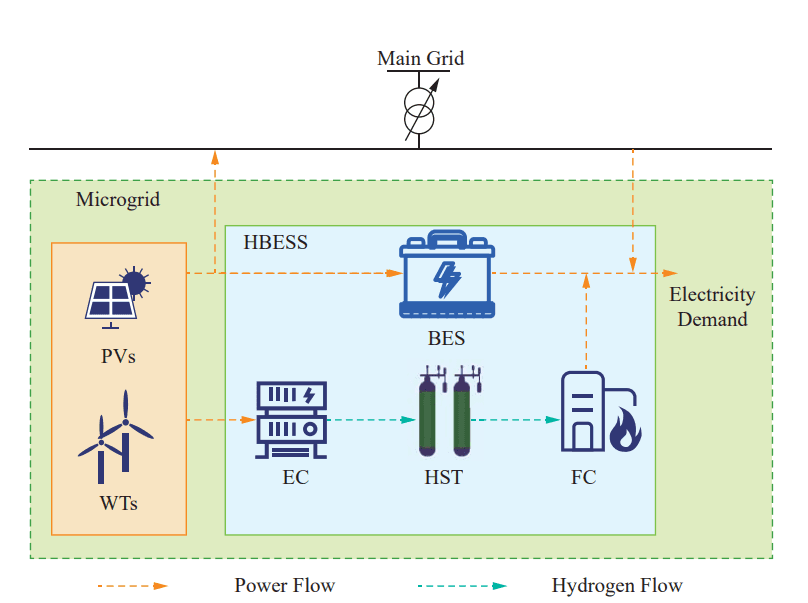
A team led by Professor Xu Zhao from The Hong Kong Polytechnic University has introduced an innovative solution to enhance the efficiency of hybrid hydrogen-battery energy storage systems (HBESS) in microgrids. The study, published in the journal Global Energy Interconnection, presents an adaptive robust optimization approach designed to minimize operating costs while managing the state-of-charge (SoC) of battery storage.
The research addresses a critical challenge in the integration of renewable energy sources into existing power grids. By optimizing the operation of HBESS within microgrids, the proposed model could significantly improve energy management and reduce costs associated with renewable energy storage and distribution.
The model employs a two-stage approach: a day-ahead stage using robust optimization to establish hydrogen dispatch and battery SoC bounds, and an intraday stage for dispatching battery storage within the defined SoC interval. This method allows for more efficient handling of uncertainties in energy demand and supply, a common issue in renewable energy systems.
Simulation results have demonstrated the model's exceptional performance, efficiency, and resilience. The study's findings could have far-reaching implications for the energy sector, potentially accelerating the transition to more sustainable and cost-effective power systems.
The research was supported by grants from the National Natural Science Foundation of China and a PolyU research project, highlighting the international collaboration in addressing global energy challenges. As the world continues to seek solutions for clean energy integration, this study represents a significant step forward in optimizing hybrid energy storage systems and improving the viability of microgrids.
The development of such advanced optimization techniques could lead to more widespread adoption of microgrids and hybrid energy storage systems, contributing to increased energy independence, reduced carbon emissions, and improved grid resilience. As the energy landscape evolves, innovations like this adaptive robust optimization approach may play a crucial role in shaping the future of sustainable power distribution and management.