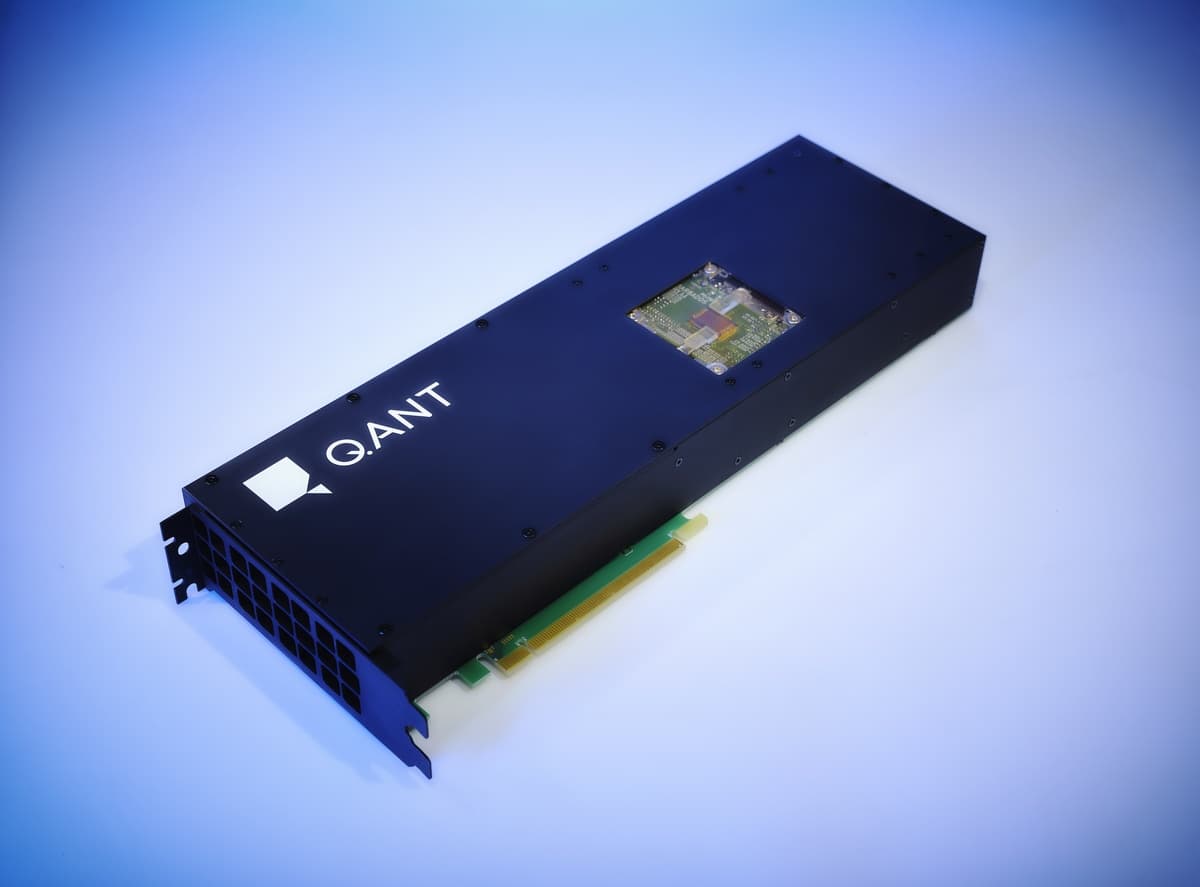
Q.ANT has announced the availability of its second-generation Native Processing Unit, the NPU 2, featuring enhanced nonlinear processing capabilities that promise significant improvements in energy efficiency and performance for artificial intelligence and high-performance computing applications. The new processor performs nonlinear mathematics natively using light, enabling entirely new classes of AI and scientific applications including physical AI, advanced robotics, next-generation computer vision, industrial intelligence, and physics-based simulation.
The timing of this advancement addresses a critical challenge in modern computing: AI's acceleration has reached the physical limits of silicon. Current GPU generations consume increasing amounts of power and water while producing substantial heat, with cooling systems accounting for up to 40 percent of total data-center energy consumption. Photonic processing fundamentally changes this equation by using light that travels faster, generates minimal heat, and can execute complex functions in single optical steps that would require thousands of transistors in conventional CMOS chips.
According to Q.ANT CEO Dr. Michael Förtsch, "Q.ANT offers the industry a new class of processors that enable performance gains beyond the incremental improvements of their digital counterparts - opening the door for superior algorithms that digital circuits cannot reach. For years, AI has raced ahead of our ability to power it — energy became the new frontier. With our NPUs, we've changed the equation." The company claims its architecture delivers up to 30x lower energy use and 50x higher performance for complex AI and HPC workloads.
The company will debut its second-generation processor at Supercomputing 2025 in St. Louis, where it will run a live image-based AI learning demonstration powered by the Q.ANT Photonic Algorithm Library (Q.PAL) on its photonic processors. The demonstration will show how Q.ANT's photonic processors achieve more accurate results with fewer parameters and fewer operations compared to conventional CPU-based systems.
Dr. Förtsch emphasized the rapid scaling of photonic computing compared to traditional CMOS technology, stating, "Photonic computing is scaling much faster than CMOS. What took ten years for digital computing, we've just achieved in one year with photonics. The second generation of our Native Processing Unit shows how rapidly this transition is happening and why efficient, light-based computation will drive the next wave of AI and HPC."
The NPU 2 introduces an enhanced nonlinear processing core with optimized analog units for nonlinear network models that dramatically reduce parameter counts and training depth while improving accuracy for image learning, classification, and physics simulation. The system is delivered as a turnkey 19-inch rack-mountable server called the Native Processing Server NPS, which contains multiple NPU 2 processors and integrates seamlessly with existing CPUs and GPUs via PCIe and C/C++/Python APIs.
In practical applications, photonic processors can execute nonlinear neural networks far more efficiently, making computer vision systems economically viable for manufacturing, logistics, and inspection tasks that were previously considered too compute-intensive. This technology will accelerate the next generation of AI architectures, including hybrid models that combine statistical reasoning with physical modeling, advancing domains such as drug discovery, materials design, and adaptive optimization where both nonlinear complexity and extreme energy efficiency are essential.
Q.ANT servers equipped with the NPU 2 processors are available to order now, with customer shipments scheduled for the first half of 2026. Each system ships as a turnkey, data-center-ready server designed to integrate seamlessly into existing HPC infrastructures.