

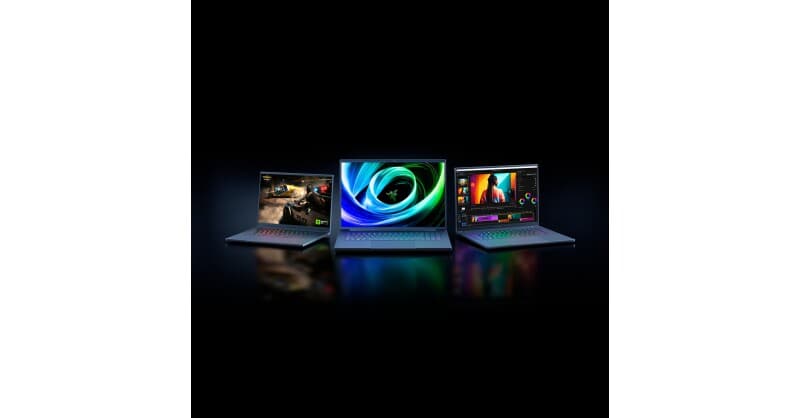
Razer has announced its 2026 Blade laptop lineup, comprising the Blade 14, Blade 16, and Blade 18, each engineered for different user profiles ranging from mobile gamers to AI developers. All models feature Razer's anodized aluminum unibody and vapor chamber cooling, with configurations including current-generation NVIDIA GeForce RTX 50 Series GPUs and fast laptop memory, paired with the latest Intel or AMD processors.
The Blade 14 is designed for gamers prioritizing portability and battery life. It weighs 1.63 kg (3.59 lbs) and measures just 0.62 inches thin, featuring up to an NVIDIA GeForce RTX 5070 GPU (115W TGP), an AMD Ryzen AI 9 365 processor, and a 14-inch QHD+ OLED display at 120 Hz. The laptop includes a 72 Wh battery and a 50 TOPS NPU for AI workloads. Pricing starts at US$2,299.
The Blade 16 targets users seeking a balance between performance and mobility. It packs up to an RTX 5090 laptop GPU (165W TGP) and an AMD Ryzen AI 9 HX 370 processor, with a 16-inch QHD+ OLED display at 240 Hz. It features up to 64 GB of LPDDR5X-9600 MHz memory and a 90 Wh battery with fast charging (50% in 30 minutes). The Blade 16 weighs 2.14 kg (4.71 lbs) and is 14.9 mm thick, starting at US$2,399.
The Blade 18 is the flagship model for hardcore gamers and AI developers, offering desktop-class performance. It includes up to an RTX 5090 GPU (175W TGP) and an Intel Core Ultra 9 290HX Plus processor (24 cores). It supports up to 128 GB of DDR5-6400 MHz slotted RAM and dual M.2 NVMe SSDs (up to 8 TB). The 18-inch display offers dual-mode options: UHD+ at 240 Hz or FHD+ at 440 Hz. With triple-fan vapor chamber cooling, it weighs 3.10 kg (7.06 lbs) and starts at US$3,499.
All models include Razer Synapse for overclocking and system control. The Blade 16 and 18 support Thunderbolt 5 for high-speed connectivity. Razer notes that configurations may vary, and customers should verify exact builds before purchasing.
For more details, visit the Razer Blade 14, Razer Blade 16, and Razer Blade 18 product pages.
The lineup underscores Razer's strategy to cater to diverse gamer and creator needs, from ultra-portable gaming to heavy AI and content creation workloads. The Blade 18's upgradeable RAM and storage, along with its high-TGP GPU, position it as a potential desktop replacement, while the Blade 14 offers all-day battery life for on-the-go users.
