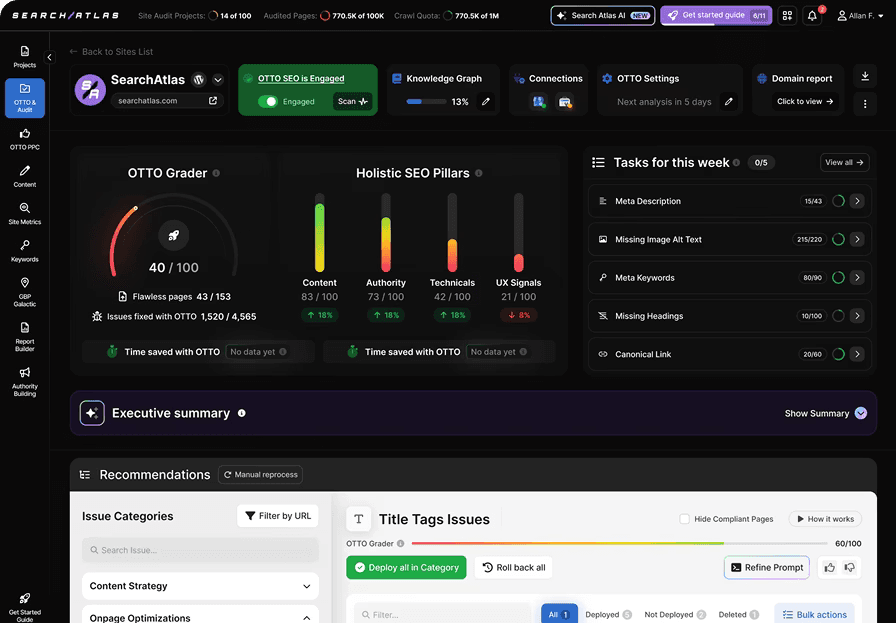
A new study analyzing automated technical SEO implementations across 39,486 websites provides empirical evidence that technical optimizations significantly improve organic search performance. The research from Search Atlas reveals sites experienced an average 146% long-term impression increase, gained 67 new ranking keywords, and improved click-through rates following automated technical fixes.
Search Atlas Founder and CEO Manick Bhan stated that the research definitively proves automated technical SEO is essential for scalable organic visibility growth. "The data shows consistent, measurable improvements across impressions, keyword coverage, rankings, and user engagement metrics," Bhan explained. The study analyzed five core SEO performance metrics—impressions, traffic, keyword coverage, click-through rate, and average search position—revealing substantial improvements.
Specific technical SEO fixes produced the strongest performance improvements, with schema markup implementation delivering a 150.5% improvement in impressions, while missing heading resolution generated 114.3% gains. Additional high-impact optimizations included canonical tag consolidation with 63.9% CTR improvement, meta keyword and title tag refinement with 61.5% CTR gains, and image alt text optimization with 64.3% keyword expansion. "The technical SEO elements that search engines use to understand and rank content—schema markup, heading structures, canonical tags—these aren't just best practices anymore," said Bhan. "Our data proves they're performance drivers with quantifiable ROI."
Researchers segmented websites into small, medium, and large clusters to identify optimization strategies tailored to different scales. Small sites benefited most from foundational fixes including schema markup and heading optimization, while medium sites gained maximum value from heading hierarchy implementation and metadata refinement. Large enterprise sites experienced the most substantial absolute gains through canonical consolidation and systematic heading hierarchy, with big sites gaining over 2,370 impressions on average. "Scale fundamentally changes the technical SEO equation," Bhan noted. "Automation enables each tier to execute their optimal strategy without proportional resource increases."
Among all metrics analyzed, click-through rate demonstrated the most consistent long-term predictive value for organic search success, particularly for medium and large websites. CTR improvements were driven primarily by resolving missing headings, optimizing title tags, implementing canonical consolidation, and deploying schema markup. "CTR is where technical SEO meets user experience," said Bhan. "When your schema markup displays rich results, when your title tags accurately represent content, when your heading structure helps search engines generate better snippets—all of this translates directly into more clicks."
The research methodology combined data from Search Atlas's Content Assistant, OTTO PPC, and Google Search Console. Researchers employed linear regression analysis, interaction terms to measure before-and-after changes, and k-means clustering on log-transformed metrics to segment websites by size. Statistical significance was confirmed through p-values and R² testing, with outlier exclusion via IQR and Z-score thresholds ensuring data integrity. "With nearly 40,000 websites analyzed and rigorous statistical controls, this research provides the SEO industry with empirical proof that automated technical SEO delivers measurable, predictable results," Bhan concluded.