

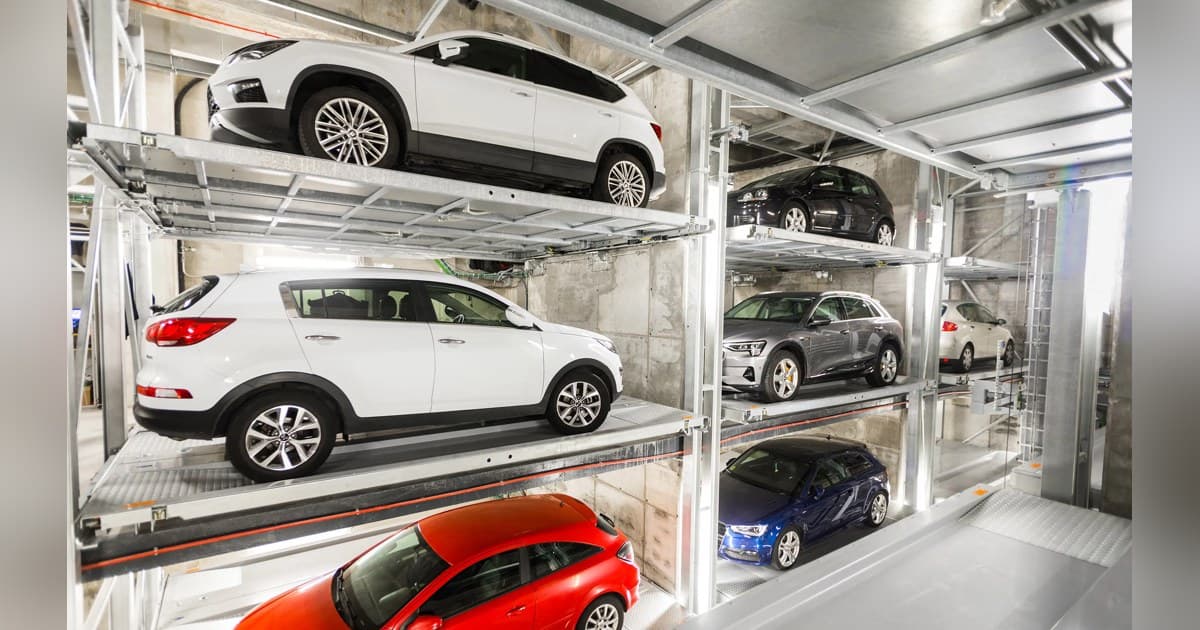
Developers weighing parking options on constrained sites are confronting a new cost variable: since July 2026, imports from the European Union have carried a 15% all-inclusive tariff ceiling under the new EU-US trade framework, while steel and aluminum content continues to carry a separate 50% Section 232 duty on top of that ceiling. The change matters to anyone specifying building systems sourced from Europe, but according to KLAUS Multiparking America, it does not upend the economics that have long favored mechanical parking over conventional ramp structures.
The U.S. subsidiary of the German manufacturer assembles its systems domestically from modular components manufactured in Germany, meaning its equipment carries tariff exposure as well. Christopher Tiessen, President and CEO of KLAUS Multiparking America, said that exposure does not change which option comes out ahead, but it does mean the comparison must be run honestly on both sides.
"If a developer's instinct is to avoid our line item by defaulting to a conventional ramp structure instead, that's the wrong read on the numbers," Tiessen said. "They're not avoiding tariff exposure by doing that; they're buying tariff-exposed steel in far greater volume, on a structure that already costs several times more per space once you account for the additional floor area."
The scale of that gap is significant. Conventional structured parking runs at a national median of roughly $33,300 per space, a figure that already reflects steel, concrete and labor costs that have climbed independently of trade policy. A cast-in-place or precast ramp structure also requires far more built area to do the same job, including ramps, drive aisles and circulation that mechanical systems do not require.
For developers, the implication extends beyond the parking line item itself. Mechanical parking turns space that would otherwise go to ramps and oversized footprints into buildable or leasable area, which can change how many units or how much additional program fits on a constrained site. Tiessen described that capacity as the number that moves a pro forma, with a tariff percentage on equipment cost representing one variable inside a much larger calculation.
He also argued that the practical takeaway for architects and developers is to plan early rather than attempt to avoid tariffs altogether, which he said is not really an option for anyone sourcing specialized building systems. KLAUS quotes tariff exposure as a transparent, itemized cost rather than folding it into an opaque total, so developers can compare real numbers instead of assumptions.
"Trade policy is going to keep evolving," Tiessen said. "Our job is to make sure that doesn't change the answer to the question that actually matters: what gets the most usable space out of the site they have."
