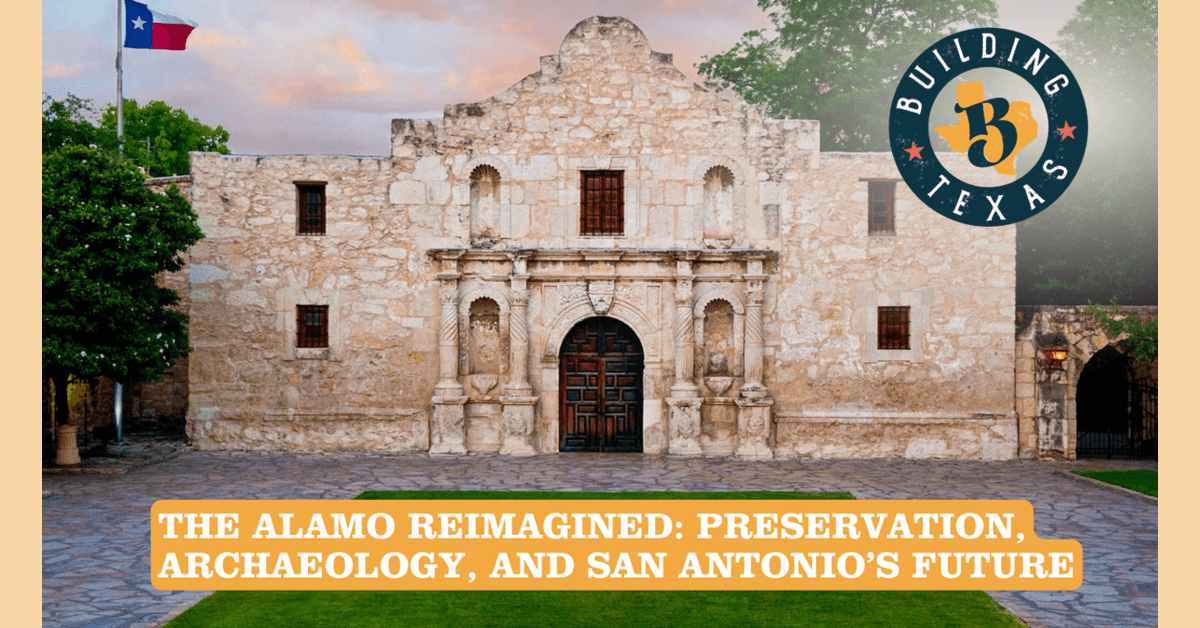
The Alamo, a UNESCO World Heritage Site and one of America's most iconic historical landmarks, is undergoing a $550 million public-private transformation that will reshape its role as both a preservation project and economic catalyst for downtown San Antonio. This investment represents one of the most ambitious historic preservation efforts currently underway in the United States, with implications for tourism, education, and urban development in Texas's second-largest city.
Emily Baucum, communications leader at The Alamo, explained during an interview on The Building Texas Show that the site is owned by the people of Texas and managed by the Texas General Land Office, with daily operations led by Alamo Trust, Inc. This governance structure ensures statewide accountability while maintaining on-the-ground stewardship of a site that attracts international visitors from Europe, Asia, and Australia. "People around the world plan travel around UNESCO World Heritage Sites," Baucum noted. "For many international visitors, the Alamo isn't just a Texas story—it's an American story and a global story."
The redevelopment plan rests on three foundational pillars: preservation of the Alamo Church and Long Barrack as fragile historical artifacts, reclaiming the historic four-and-a-half-acre battlefield footprint that was overtaken by commercial growth in the late 19th century, and building a world-class visitor center and museum scheduled to open in late 2027. This comprehensive approach reframes the Alamo not as a single building but as a complete historical landscape shaped by Indigenous peoples, Spanish colonists, Mexican history, the Texas Revolution, and modern preservation efforts.
Ongoing archaeology continues to reveal new dimensions of the site's history, with recent excavations uncovering more than 250,000 artifacts near the Long Barrack alone, including musket balls, weapon fragments, and Spanish mission-era flooring. These discoveries directly influence construction plans and deepen understanding of daily life across centuries. "For many visitors, this is the only place they'll ever see active archaeologists at work," Baucum shared. "It brings history to life, especially for kids."
The transformation extends beyond the historic structures to include significant improvements to Alamo Plaza, creating a walkable, educational public space. Recent additions include the Mission Gate & Lunette artistic interpretation of southern fortifications, Plaza de Valero—a $20 million community park and performance space—and The Promenade, which converts former vehicle streets into pedestrian pathways with interpretive panels and public art. Later this spring, the Paseo del Alamo will reopen, reconnecting the Alamo with the San Antonio River Walk through The Building Texas Show.
Education remains central to the Alamo's mission, with The Ralston Family Collection Center currently displaying more than 500 artifacts—many never before seen by the public—and the Texas Cavaliers Education Center opening in 2025 to provide dedicated space for student learning. The forthcoming Visitor Center and Museum will expand this educational impact with eight galleries telling the full 300-year story of Texas history and an event space capable of hosting up to 700 people with panoramic views of the San Antonio skyline.
As downtown San Antonio experiences significant growth with new sports, convention, and cultural investments, the Alamo serves as both a cultural cornerstone and economic catalyst. The project positions the site to support tourism, education, and civic pride while making history accessible, inclusive, and meaningful for future generations. The full conversation detailing this transformation is available for those interested in understanding how this historic site is being reimagined for the 21st century.