

Solid American hardwoods have served as a flooring standard in the United States since the nation's founding, and recent residential projects across New England show why the material continues to hold that position. Oak, walnut, maple and ash can be sanded and refinished for decades, allowing floors to outlast heavy foot traffic, pets and changing design trends while gaining character over time. The material is available in multiple widths, grades and finishes and is considered easy to install.
"American hardwoods are grown, harvested, and milled right here, giving architects and builders a reliable, high-quality supply," Ian Faight of the American Hardwood Information Center said in a NewsUSA report. "Nothing rivals hardwood's warmth and natural variation, and as a low-emission, renewable resource, it supports healthier interiors and everyday well-being."
The importance of that supply chain extends beyond aesthetics. Domestic production gives builders a dependable source of material, while the renewable nature of hardwood forests and low-emission finishes align with growing demand for healthier indoor environments. For homeowners, the practical implication is a floor that can be refinished rather than replaced, potentially reducing long-term renovation waste and cost.
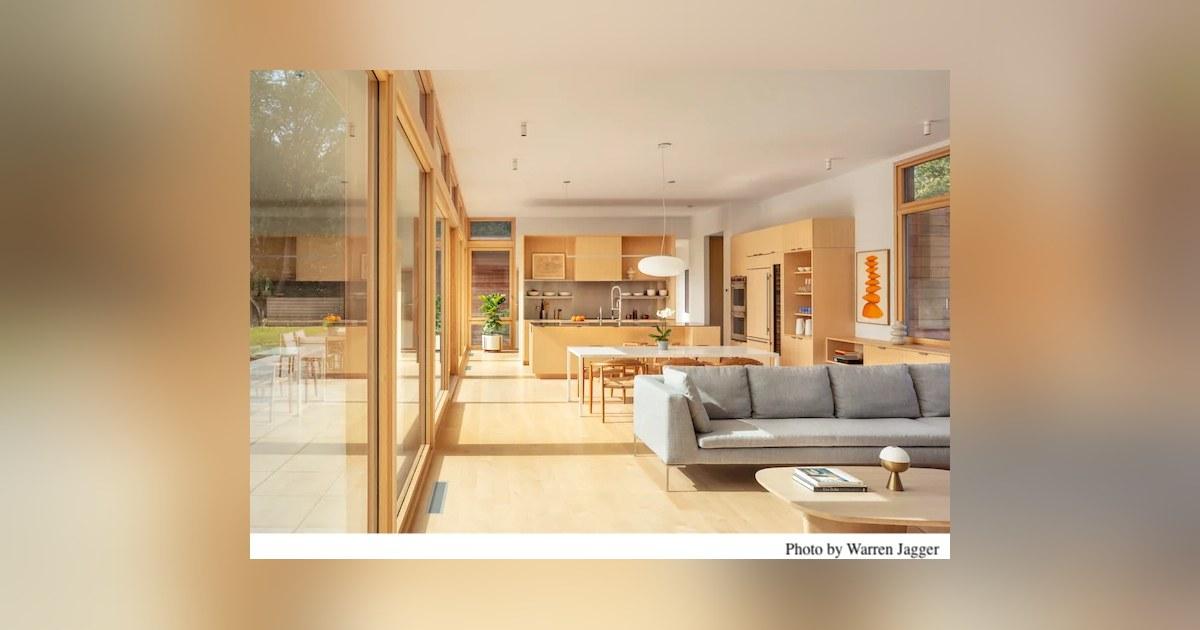
Six projects illustrate the range of applications. In East Greenwich, Rhode Island, a low-slung modern home by Estes Twombly + Titrington Architects uses 5-inch-wide hard white maple boards from Vermont Plank Flooring in the kitchen, dining and living areas, finished with the company's Killington Peak stain to draw out warm golden-brown tones. Clear-finished maple window frames, trim and cabinetry continue the material palette.
In Charlestown, Rhode Island, a new shingle-style house by Arnold Design Group features select-grade ash treads on a custom spiral stair circled by a wrought-iron balustrade. The light-toned wood gives the traditional element a clean, modern look, and the landing uses 7-inch-wide boards in the same wood, some laid in herringbone with walnut accent borders.
Architect Stephanie Horowitz of ZeroEnergy Design specified old-growth white oak, quartersawn for stability and ray-fleck grain, in a Wellesley, Massachusetts, house built to rigorous green-building standards. The flooring is left uncovered by rugs or carpet, which Horowitz avoids as sources of dust and allergens.
In a 19th-century Boston townhouse renovated by Stern McCafferty Architecture + Interiors, roughly 4,000 square feet of select-grade walnut from Vermont Plank Flooring runs throughout, including a child's bedroom with a built-in daybed nook. The 6-inch planks were finished on-site with a water-based, satin-sheen treatment.
A whole-house renovation in Dighton, Massachusetts, extends natural character-grade white oak from Hull Forest Products into the primary bathroom, where 8-inch live-sawn planks run past the vanity toward a freestanding tub and glass shower. White oak's cell structure resists moisture better than many woods, though area rugs and prompt spill cleanup remain essential.
On a Rockport, Massachusetts, peninsula, Ruhl Studio Architects raised an existing house on concrete pilings to clear flood requirements and capture ocean vistas. Red oak in 6-inch boards, finished with a low-sheen Waltham stain, gives the open living space a light, airy foundation for a home designed for three generations.
More information about using American hardwoods is available at www.hardwoodinfo.com.
