A groundbreaking study published in Science has achieved a significant advancement in thermal photonics, enabling efficient subambient daytime radiative cooling for vertical surfaces. This development could have far-reaching implications for energy efficiency in buildings, vehicles, and other applications.
The research, led by Prof. Wei Li from the Changchun Institute of Optics, Fine Mechanics and Physics of the Chinese Academy of Sciences, in collaboration with teams from Stanford University and the City University of New York, utilized thermal photonics to achieve cross-band synergistic control of thermal radiation in both angle and spectrum.
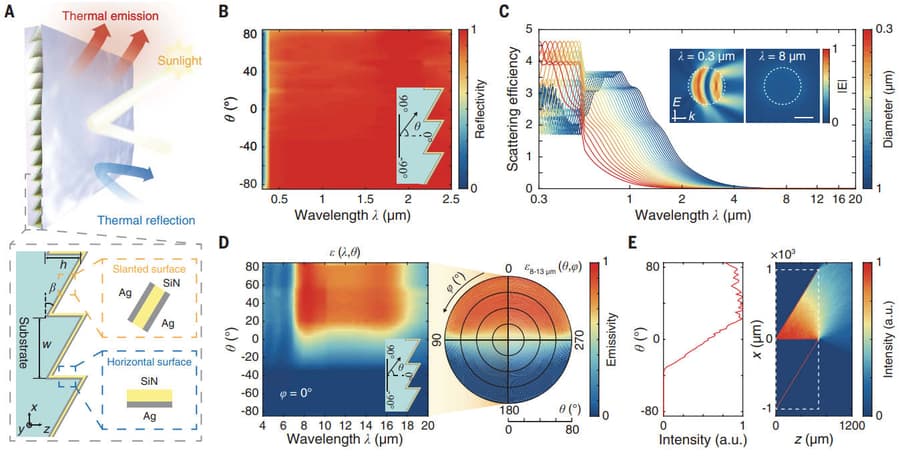
The team designed an angularly asymmetric and spectrally selective thermal emitter (AS emitter) using a cross-scale symmetry-breaking structure. This innovative design allows for subambient radiative cooling on vertical surfaces, a feat previously unattainable with conventional radiative coolers that were limited to horizontal surfaces.
The AS emitter maintained a steady-state temperature substantially below the ambient temperature throughout the day. Even under peak sunlight, it maintained a temperature 2.5°C below ambient, outperforming conventional high-performance radiative coolers and commercial white paint by 4.3°C and 8.9°C, respectively.
This breakthrough addresses a significant limitation in current cooling technologies. Traditional radiative coolers, due to their omnidirectional thermal radiation properties, were only effective on horizontal surfaces. When applied to vertical surfaces, their efficiency was drastically reduced due to the limited field of view to the cold sky and heat absorption from surrounding objects and the atmosphere.
The implications of this research are substantial. The technology could be applied to a wide range of real-world scenarios involving inclined or vertical surfaces, such as building walls, clothing, and vehicle sides. This could lead to significant reductions in energy consumption for cooling, contributing to global efforts in energy conservation and sustainability.
As climate change continues to drive temperatures up worldwide, innovations in cooling technology become increasingly crucial. This advancement in thermal photonics offers a promising solution for more efficient and sustainable temperature control in various applications, potentially reshaping approaches to thermal management in urban environments and beyond.
The study, funded by the National Natural Science Foundation of China, the US Department of Energy, and a Vannevar Bush Faculty Fellowship, represents a dimensional leap in radiative cooling technology. It opens up new possibilities in the field of energy and sustainability, offering innovative thermal management solutions for energy-efficient technologies across various applications.