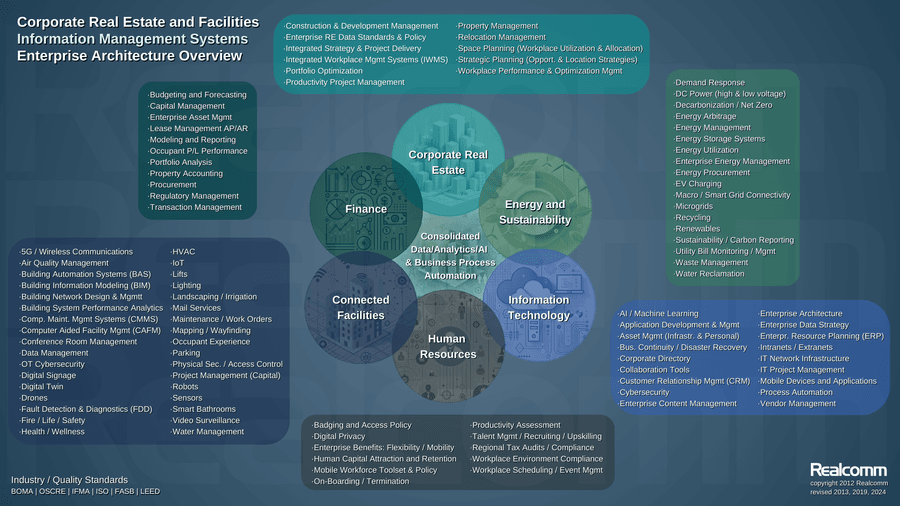
Realcomm Conference Group, LLC has released an updated version of its Corporate Real Estate and Facilities Information Management Systems Enterprise Architecture Overview infographic, revealing that many organizations are still struggling to implement fully integrated enterprise architecture in the corporate real estate (CRE) and facilities space. The new infographic, which closely aligns with the original 2012 version, underscores the slow pace of adoption for comprehensive information management systems in the industry.
Despite significant technological advancements in areas such as mobility, smart buildings, and data analytics over the past decade, the updated infographic indicates that many core elements from the 2012 framework remain relevant today. This suggests that while incremental innovations have occurred, broader adoption of fully integrated enterprise architecture remains a challenge for much of the industry.
Key aspects of the updated infographic include a consistent focus on fundamental CRE and facilities systems, the persistence of cross-departmental integration challenges, and the growing importance of data-driven decision-making. However, the infographic also highlights that most organizations have only partially realized the potential of advanced analytics, AI, and automation in their operations.
Jim Young, Co-Founder and CEO of Realcomm, emphasized the slow adoption of comprehensive information management systems, stating, "The fact that so many elements from our original infographic remain relevant today speaks to the slow adoption of these strategies, even though the potential benefits for integrated and automated workflows are more critical than ever."
The updated infographic reaffirms the opportunity for greater collaboration between departments such as Corporate Real Estate, Connected Facilities, Energy and Sustainability, IT, Finance, and Human Resources. However, it also reveals that very few organizations have achieved the seamless integration outlined in the original framework, with disparate systems, siloed data, and under-utilization of automation tools continuing to hinder progress.
This revelation has significant implications for the CRE and facilities management industry. Organizations that fail to adopt integrated, data-centric methodologies may find themselves at a competitive disadvantage, missing out on operational efficiencies, cost savings, and improved decision-making capabilities. The persistent challenges highlighted in the infographic also suggest a need for increased focus on change management, staff training, and investment in technology infrastructure to overcome integration hurdles.
The updated infographic will be presented and debated at CoRE Tech 2024, scheduled for November 19-20, 2024, in San Jose. This event provides an opportunity for industry professionals to discuss strategies for overcoming integration challenges and accelerating the adoption of comprehensive information management systems in corporate real estate and facilities management.