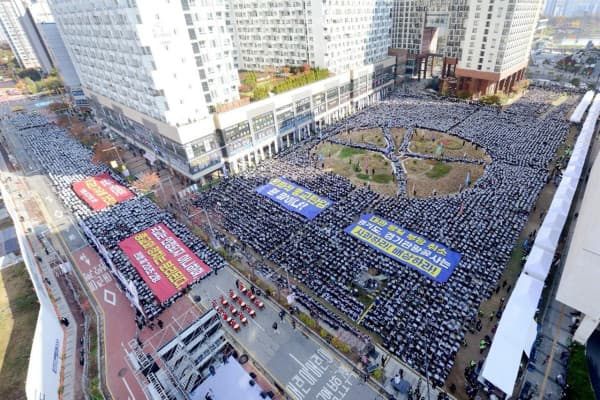
Gyeonggi Province's abrupt cancellation of the Shincheonji Church's "Religious Leaders Forum and Completion Ceremony" has ignited a firestorm of controversy and protests involving more than 25,000 people. The event, scheduled for October 30 at Paju Imjingak Peace Nuri, was called off just one day prior, citing unspecified security concerns.
Shincheonji Church officials have vehemently contested the decision, labeling it unconstitutional and discriminatory. They argue that the cancellation was politically motivated and influenced by pressure from other religious groups, particularly the Metropolitan Christian Council of Korea (MCCK), which has a history of criticizing Shincheonji.
The controversy has escalated into a significant debate on religious freedom in South Korea. Shincheonji Church contends that the cancellation violates Article 20 of the South Korean Constitution, which guarantees freedom of religion. This incident has raised questions about the government's role in religious affairs and the potential for discrimination against minority religious groups.
In response to the cancellation, Shincheonji Church organized a peaceful protest rally on November 15 outside the Gyeonggi Provincial Office. During a meeting with provincial officials, Chief Public Relations Officer Song Jae-Woong demanded an official statement of responsibility from the governor and sought compensation for financial damages incurred due to the event's cancellation.
The implications of this controversy extend beyond the immediate conflict between Shincheonji Church and Gyeonggi Province. It highlights the delicate balance between ensuring public safety and protecting religious freedoms, a challenge faced by governments worldwide. The incident also underscores the potential for inter-religious tensions to influence government decisions, raising concerns about the separation of religion and state.
As Shincheonji Church continues its protests, the outcome of this dispute could set a precedent for how religious events are handled by local authorities in South Korea. It may also prompt a broader national discussion on religious tolerance and the rights of minority religious groups in the country.
The controversy serves as a reminder of the complex interplay between religious rights, public safety, and government responsibility. As the situation unfolds, it will likely draw attention from human rights organizations and religious freedom advocates both within South Korea and internationally, potentially influencing future policies on religious events and freedom of assembly.