

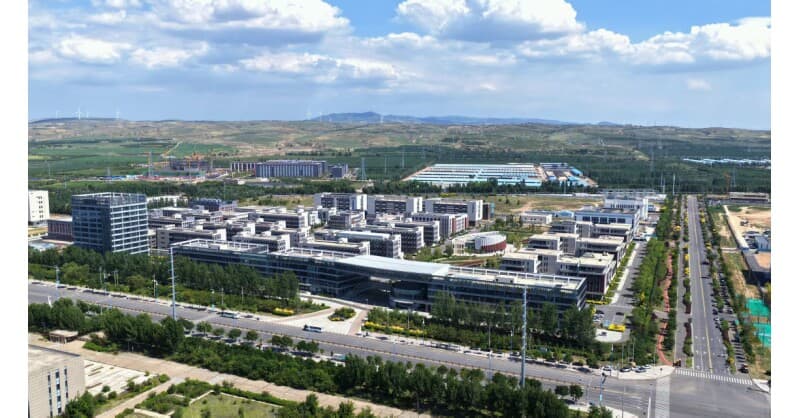
The fourth annual Green Computing Power (Artificial Intelligence) Conference, held on August 22, 2026, on the Cilechuan Grassland in Hohhot, Inner Mongolia, has spotlighted the city's pioneering efforts to merge renewable energy with high-performance computing. The event, themed 'Building Synergy between Computing and Electricity, Exploring New Horizons in Token Economy, and Creating the Future of Artificial Intelligence Together,' unveiled the Green Computing Power Development Research Report (2026) and launched pilot projects for 'millisecond-level urban computing.' Major companies, including ByteDance and Cambricon, signed agreements worth tens of billions of yuan to develop green intelligent computing centers and token factories.
The conference drew attention to Hohhot's unique advantage: a vast grassland where wind turbines generate clean electricity that directly powers nearby data centers via a dedicated 41-kilometer transmission line. This setup bypasses the public grid, ensuring that GPU arrays operate primarily on wind and solar energy. The significance is underscored by the fact that training large-scale AI models with tens of thousands of GPUs can consume over 100 million kilowatt-hours annually. For instance, the Hohhot Intelligent Computing Center operated by China Mobile incurred electricity costs of approximately 290 million yuan in 2025, representing over 70% of its total operating expenses. This cost factor is decisive in the competitive computing power landscape, driving China's 'East Data West Computing' strategy, which shifts high-demand computing from eastern regions to resource-rich western areas. Hohhot's Horinger data center cluster is among the nation's top ten such clusters.
Hohhot offers nearly optimal conditions for data center location. With an average annual temperature of 7°C and over 200 days suitable for direct outdoor air cooling, cooling costs are reduced by more than 20%. At an electricity price of about 0.36 yuan per kilowatt-hour, a large-scale GPU cluster can save around 50 million yuan annually. Currently, Hohhot's total computing capacity reaches 150,000 P, with green electricity usage exceeding 80%.
However, the intermittent nature of wind and solar power poses a challenge to the 24/7 power supply required by computing loads. The local solution is an innovative 'computing-electricity synergy' mechanism. China Huadian Corporation has built a 360,000-kilowatt integrated wind-solar-storage power station, combining 300,000 kilowatts of wind, 60,000 kilowatts of photovoltaic, and four-hour energy storage. A collaborative control platform collects data on wind output, solar irradiance, storage status, and computing load at millisecond intervals to dynamically allocate power. When green energy is abundant, storage systems charge and delay-tolerant tasks are prioritized; when it is limited, storage discharges, the grid supplements, and flexible tasks are deferred. This bidirectional interaction transforms the traditional unidirectional supply model.
On the consumption side, waste reduction is also key. The China Mobile data center recovers waste heat from nearby power plants for cooling, improving its Power Usage Effectiveness (PUE) from 1.315 to 1.209, saving 560,000 kilowatt-hours annually. Once two machine halls are fully operational, annual savings are projected to reach 10 million kilowatt-hours and 150,000 tons of water.
Today, 62 computing center projects have clustered in Hohhot, including data centers from China's three major telecom operators, 16 financial institutions, and computing nodes from Huawei, ByteDance, and Kuaishou. Upstream, 45 manufacturing enterprises produce servers, cabinets, and sensors locally. According to a recently published three-year action plan, by 2028 Hohhot aims to establish 10 token factories capable of producing 20 trillion tokens daily. This would enable customers to procure not only cabinets and bandwidth but also directly accessible intelligent services tailored to their needs.
The prairie winds remain constant, as does Hohhot's commitment to converting every kilowatt-hour of green electricity into stable, reliable computing power. This conference underscores the economic and environmental significance of integrating renewable energy with AI infrastructure, setting a precedent for sustainable computing worldwide.
