

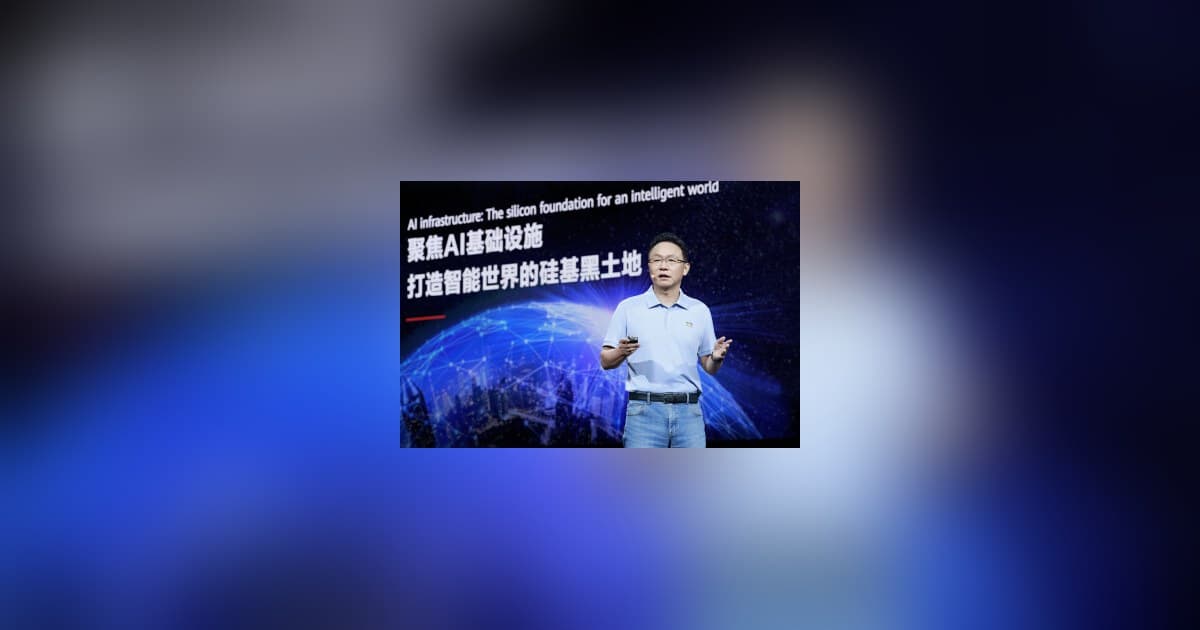
At HUAWEI CONNECT 2026 in Shanghai, Huawei Deputy Chairman and Rotating Chairman David Wang delivered a keynote titled "Advancing the Agentic World, Building a Solid Silicon Foundation," unveiling a suite of AI infrastructure products that the company says will underpin the coming intelligent world. The announcements, made during the event's first keynote, highlight Huawei's strategic focus on computing power and its efforts to build open ecosystems.
Wang framed the urgency of the moment with data: foundation model parameters are approaching 10 trillion and are projected to exceed 100 trillion by 2030. In China alone, daily inference token consumption has surged to around 500 trillion and is expected to reach quintillions by 2030. On-device AI is also advancing rapidly, with smartphone models growing from three billion parameters in 2024 to 30 billion today. These trends, Wang argued, demand a solid silicon foundation.
Central to Huawei's strategy are SuperPoDs and SuperClusters. The company unveiled the Atlas 960E SuperPoD, which it calls the industry's first to use near-packaged optics (NPO). A single Atlas 960E can scale to 4,096 NPUs, deliver 8 EFLOPS of FP8 compute, and support up to 1 petabyte of HBM capacity. By using 5,500 Hi-ONE optical interconnect units, it eliminates the need for 48,000 traditional 800G optical modules, cutting power consumption by over 550 kilowatts and doubling fault-free operating time to achieve 99.8% system availability. Huawei also upgraded its TaiShan 950 SuperPoD and launched the OceanStor M900, a context memory storage system for agentic inference.
The company's agentic SuperCluster, interconnected with UnifiedBus, can scale up to one million NPUs using a two-tier, four-plane Clos architecture. According to Huawei's Markov Lab simulations, a 100k-NPU cluster built with 4k-NPU SuperPoDs can deliver a 2.75x increase in Model FLOPs Utilization compared to one composed of 8-NPU servers. This matters because traditional server architectures see intra-cluster communications consume over 40% of total training time, severely limiting efficiency.
Huawei's silicon roadmap includes the Ascend 960 series, with the 960DT slated for Q1 2027 and the 960PR for Q3 2027. Wang said the company is evolving Ascend on a one-generation-a-year cycle, with Ascend 970 and 980 to follow in 2028 and 2029. The company also submitted an implementation agreement on NPO to the Optical Internetworking Forum, signaling broader industry standardization efforts.
Beyond hardware, Huawei emphasized open ecosystems. The Kunpeng ecosystem now attracts over 4.16 million developers and 7,200 partners, while CANN has moved to sustained, community-driven open-source development, with external developers now comprising 61% of all CANN developers. Ascend supports over 90 leading third-party open-source projects and is officially supported as a PyTorch accelerator backend. For more information, visit www.huawei.com/en/events/huaweiconnect.
Wang concluded that AI "may well be the final technological revolution in human history" and stressed that no single company can build an intelligent world alone. The announcements position Huawei as a key player in AI infrastructure, with implications for industries reliant on large-scale computing. The issuer is solely responsible for the content of this announcement, distributed via Media OutReach Newswire.
