

Huawei's consumer business is mounting a significant comeback, underpinned by record research and development spending and a new chipmaking breakthrough that could alter the global technology supply chain. At an international media roundtable in Shenzhen, Richard Yu, Executive Director and Chairman of the Investment Review Board, detailed how Huawei invested more than CNY1.8 trillion (approximately $250 billion) in R&D between 2007 and 2025, with annual spending rising from 10% to over 20% of revenue. That investment has yielded the Kirin 9050 Pro chip, which powers the newly launched Mate 90 series and delivers 31% higher performance than its predecessor.
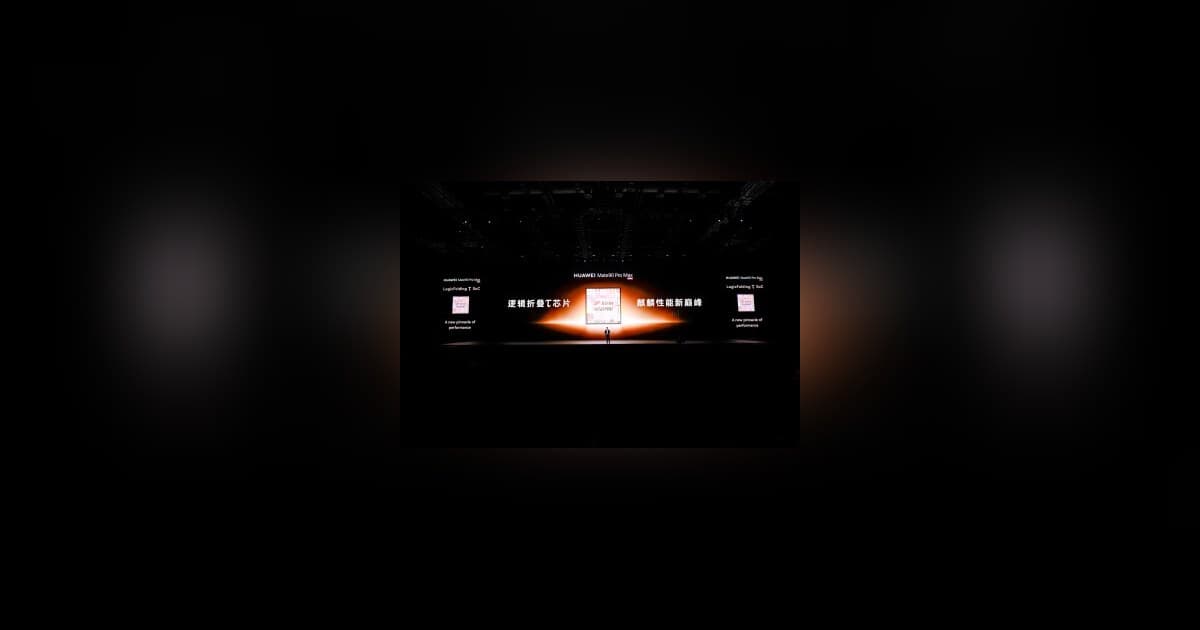
The chip's most notable feature is LogicFolding technology, developed under the Tau Scaling Law and unveiled by He Tingbo, head of Huawei's Semiconductor Business Department, this May. LogicFolding vertically stacks logic layers and restructures circuit layouts through high-density interconnects to shorten critical paths and reduce latency. This allows the Mate 90 series to run a 30-billion-parameter mixture-of-experts AI model entirely on-device. Yu confirmed that more Huawei phones will adopt LogicFolding chips in the future, despite current constraints on advanced semiconductor production capacity in China. "We hope that production capacity will ramp up in China's semiconductor industry," Yu said, noting that capacity is also needed for Huawei's Ascend AI chips.
Beyond hardware, Huawei's HarmonyOS ecosystem is gaining scale. More than 90 million devices—including smartphones, PCs, and tablets—now run HarmonyOS 6 and 7, a figure expected to reach 100 million by year-end. The platform hosts over 450,000 apps and services, 11 million registered developers, and 23,000 app innovation partners. Yu revealed that Huawei is considering gradually bringing HarmonyOS to the global market, a move that would intensify competition with Apple's iOS and Google's Android.
Huawei's globalization efforts are also showing signs of recovery. Though the company now sells only a few million smartphones annually outside China, it leads the global wearable market and is growing in TWS earbuds. HarmonyOS-based tablets are performing strongly, and CPE mobile routers are connecting remote regions. Yu acknowledged past reliance on US technologies but stated that Huawei has "basically gotten rid of the dependence on US technologies" by developing its own operating system, tools, and domestic chip manufacturing since 2023.
The implications for the tech industry are profound. Huawei's progress demonstrates that despite export controls, a viable non-US technology stack is emerging, potentially giving other nations an alternative to American-dominated systems. For consumers, on-device AI capabilities could enable more powerful and private applications. For competitors, Huawei's vertical integration—from chips to operating systems—sets a new benchmark. The full Q&A session is available at https://www.apmultimedianewsroom.com/multimedia-newsroom/continuous-innovation-securing-our-competitive-edge-through-technological-breakthroughs.
