

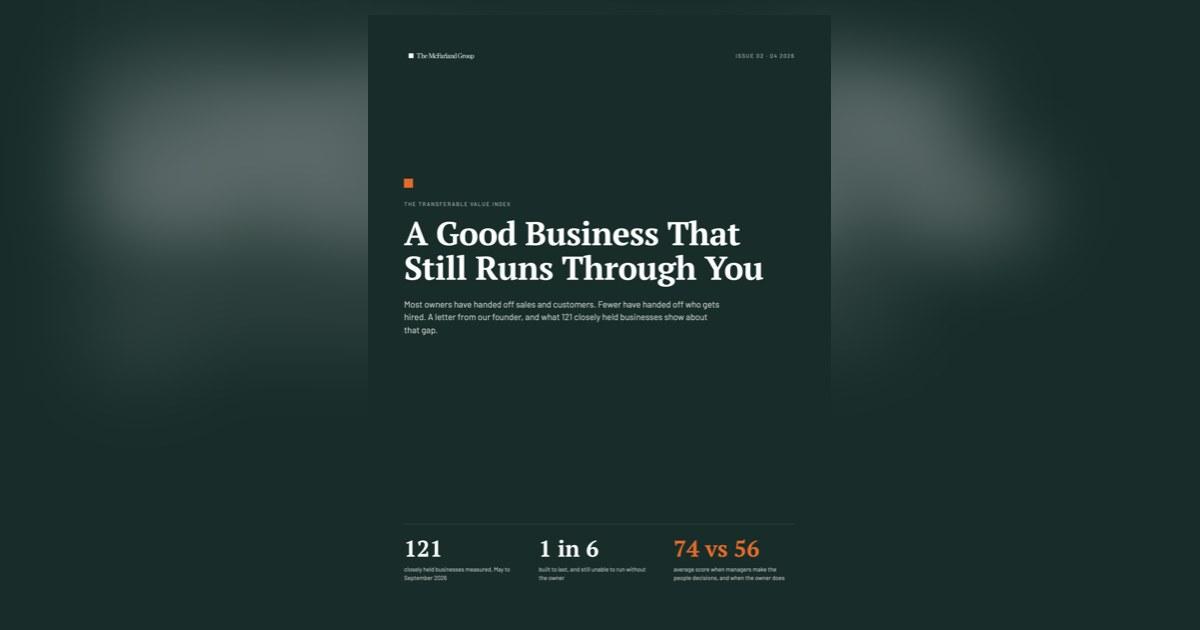
One in six closely held businesses that score near the top for durability remain so dependent on their owners that the company effectively runs through one person, according to the second issue of the Transferable Value Index published by The McFarland Group.
The quarterly index measures how well closely held companies hold up without their owners. The new issue, titled "A Good Business That Still Runs Through You," draws on 121 assessments submitted between May 2 and September 29, 2026, reached through the firm's network, partner coaches and industry events. Test submissions were removed and repeat takers counted once.
Each business is scored on two dimensions. Business Durability covers earnings consistency, customer diversification, financial visibility, systems, workforce and resilience to disruption. Owner Independence covers whether new business, client relationships, operations, direction, financial decisions and people decisions depend on one person. Across the cohort the two dimensions correlate at 0.57, sharing about a third of their variation, which the firm says shows a business can grow much sturdier while its owner stays just as central to it.
The 19 companies in the category the index calls Owner-Dependent Success score 20.5 out of 30 on durability, close to the top bracket's 22.0, but trail it by eight points on independence, at 14.6 against 22.8.
The sharpest divide is over people decisions. Six in ten owners say their team closes most new business and holds customer relationships, but fewer than half say their managers handle hiring, pay and terminations for their own teams. Twenty-two percent say they are personally involved in most people decisions, down to front-line roles, and no other question in the index draws that many owners to its most hands-on answer.
That single question tracks closely with the rest of the score. Where managers make their own teams' people decisions, businesses average 74 out of 100 on the other eleven questions and none falls in the Owner-Run category. Where the owner stays personally involved, the average is 56 and nearly half are Owner-Run. Among Owner-Dependent Success businesses, 68 percent of owners remain personally involved in people decisions, compared with 10 percent in the top bracket.
"Building a durable business rewards involvement: your judgment, your relationships, your standards, stamped on everything," said Byron McFarland, founder of The McFarland Group. "Building an independent one requires the opposite: removing your judgment, your relationships, your standards from the machinery, one piece at a time, on purpose. Nobody does the second by accident. You have to mean it."
The finding carries into a sale. In due diligence, a buyer asks who handles terminations, because the answer shows where responsibility sits. When the answer is still the owner, the leadership team has never made the hardest call in the building. The issue recommends most owners start with people decisions and hand them to the managers who will own them after the ownership transition. As in the inaugural issue published in August, the question of who decides what the business does next scores lowest of the twelve on average, at 2.78 on a five-point scale.
The full issue, including McFarland's letter, a map of all 121 businesses and a complete question-by-question breakdown, is free to download without a form at The McFarland Group's blog. The assessment itself is free at transferablevalueindex.com, takes about four minutes and returns a score on both dimensions plus a placement in one of four categories.
The index's authors caution that owners who take the assessment are already thinking about an ownership transition, and the shares should be read in that light. Even so, the results suggest that for owners weighing a sale or a management buyout, the most consequential work may be the least visible: deciding who, other than the owner, makes the call on hiring, pay and terminations.
