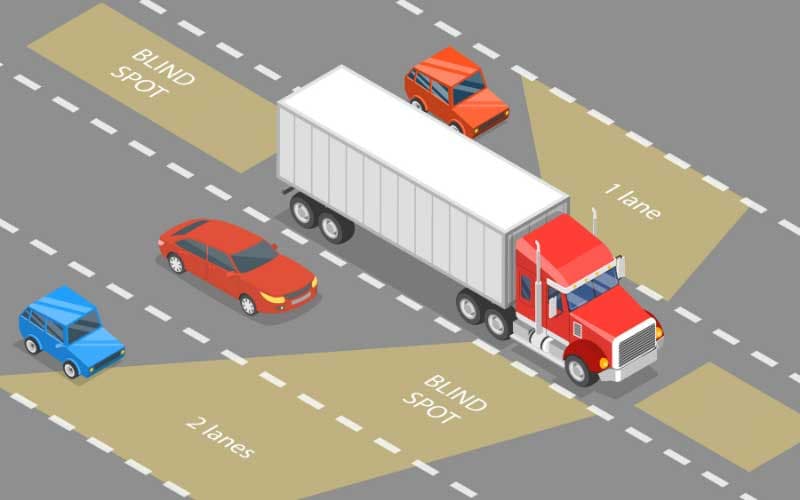
Semi truck blind spots represent a persistent and dangerous reality on Georgia highways, where collisions often occur because drivers of large commercial vehicles cannot see smaller cars in critical areas around their trucks. These blind areas, officially termed "No-Zones" by the Federal Motor Carrier Safety Administration, can extend for several car lengths along each side of a trailer, approximately 20 feet in front of the cab, and nearly 200 feet behind the truck, creating invisible hazards for surrounding traffic.
The danger is amplified by the substantial weight difference between vehicles. A fully loaded semi can weigh up to 80,000 pounds, compared to approximately 3,000 pounds for a typical passenger car. When a truck moves into a space occupied by a smaller vehicle, the physics of the collision means the smaller vehicle absorbs nearly all of the impact force. From the elevated driver's seat of a commercial truck, compact cars near the front bumper or alongside the trailer can completely disappear from view.
Georgia's specific traffic patterns exacerbate this problem, particularly on heavily traveled corridors where blind spot crashes occur frequently. Interstate 75 through metro Atlanta, Interstate 85 with its complex interchanges near the Perimeter, Interstate 20 through Augusta and Atlanta, and Interstate 285—often cited as one of Georgia's most dangerous roads for truck-related collisions—present heightened risks due to congestion and frequent lane changes. Common scenarios include lane changes, merges from short ramps, and wide right turns through busy intersections.
The article "Semi Truck Blind Spots: A Hidden Danger on Georgia Roads" at https://grahamlawga.com/semi-truck-blind-spots-accident-compensation/ identifies four primary blind spot zones: directly in front of the truck; up to 200 feet behind the trailer; the especially hazardous right-side zone where right-turn squeeze crashes and lane-change impacts are common; and the left-side blind area, which is smaller but still wide enough to hide a car riding along the rear half of the trailer. Many collisions begin with a truck signaling and easing over while the driver in the smaller vehicle has insufficient time or space to react.
Determining fault in these crashes can involve multiple parties, including the truck driver who failed to execute a safe maneuver, the trucking company that may have enforced unrealistic schedules or provided inadequate supervision, maintenance providers who neglected mirror systems, and cargo loading companies whose errors affected vehicle handling. Building these cases typically requires examination of driver logs, electronic data from the truck, inspection reports, and training histories.
Georgia law establishes specific parameters for these incidents. Under O.C.G.A. § 9-3-33, most personal injury claims must be filed within two years. Georgia's modified comparative negligence rule bars recovery if an injured person is found to be 50 percent or more at fault and reduces compensation proportionally if fault is lower but still present. Insurance carriers sometimes argue that smaller vehicles should not have been in the no-zone, making photographic evidence, electronic data, and witness accounts crucial for establishing facts.
This issue matters because it addresses a preventable safety hazard affecting thousands of Georgia drivers daily. The combination of physical blind spots and legal complexities creates situations where injured parties may feel blamed for simply using public highways. Understanding both the mechanical realities of truck no-zones and the legal principles governing responsibility after collisions provides drivers with crucial knowledge for navigating Georgia's roadways more safely and understanding their rights following accidents.