

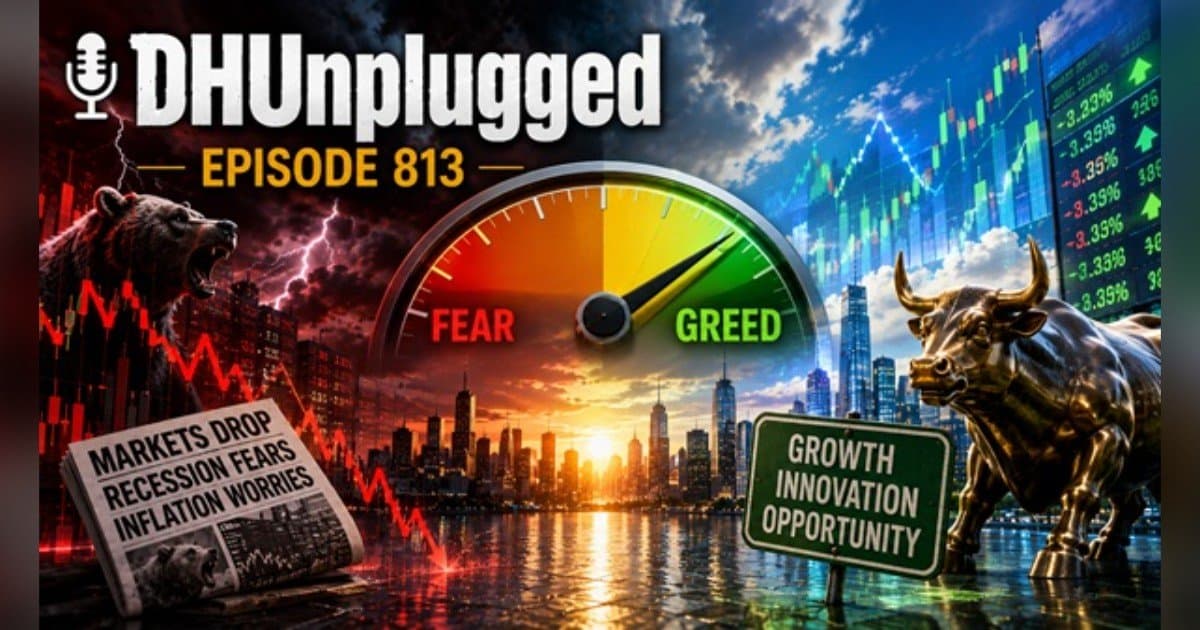
The S&P 500 has surged to new all-time highs, even as the market contends with a backdrop of war, inflation, softening GDP, and tariff reversals. In the latest episode of DHUnplugged, titled "Fear and Greed," hosts Andrew Horowitz and JC Dvorak dissect the forces driving the rally, noting that with roughly 80% of S&P 500 companies having reported earnings and nearly 90% beating EPS estimates, investors are pricing in optimism ahead of Wednesday's CPI print and Thursday's PPI release.
The episode, published August 11, 2026, examines the CNN Fear and Greed Index, which currently reads near 61, indicating a state of greed. Horowitz and Dvorak discuss whether this signals market froth or a contrarian setup. They delve into the index's components, including Tom McClellan's Volume Summation Index and Horowitz's proprietary Key Reversal Indicator (KRI), to gauge market sentiment.
Friday's jobs report added to the mixed picture, showing unemployment at 4.1% with only 20,000 payrolls added, alongside a shrinking labor participation rate. Despite these weak numbers, the market has continued its upward trajectory. The hosts also cover oil's rebound after Scott Bessent's failed deal timeline, and Horowitz mentions a profitable client trade he doubled up on.
Trade policy remains a wildcard, with new 10-12% tariffs imposed on 60 trading partners, triggering lawsuits from 25 states, and Nike's reported tariff refund. These developments add to the uncertainty that investors are seemingly brushing aside.
A significant portion of the discussion focuses on mega-cap free cash flow, which had worried Horowitz heading into the quarter. Apple's free cash flow rose roughly $7.5 billion, or 31%, while Microsoft fell about $6 billion. Meta's free cash flow collapsed 91% due to Mark Zuckerberg's renewed AI spending, and Amazon swung from positive $18 billion to negative $7.6 billion. Alphabet flipped negative, Tesla turned to a $1.09 billion outflow, and Intel worsened by $7.37 billion after a $20 billion secondary. Nvidia bucked the trend, adding $22.5 billion. The hosts also touch on SoftBank's $2.2 billion quarterly profit driven by Masayoshi Son's Intel stake, and ByteDance's OpenAI funding.
Behavioral finance takes center stage as Horowitz cites Daniel Crosby's work on loss aversion. "When people are freaking out, it's usually the time to get in. When people are like, oh my God, it's never gonna get worse, the market rally is gonna continue forever, it's like time to get out," Horowitz tells listeners. Dvorak challenges him on why proprietary signals used by firms like Jane Street remain private while retail-facing indicators become content. Horowitz's response: "It's content. That's what it seems like to me at least."
The episode also includes a heartfelt recap of the Fort Lauderdale meetup honoring the late John C. Dvorak, attended by roughly 35 listeners from across Florida. This blend of market analysis and personal reflection is a hallmark of DHUnplugged, which covers Fed policy, earnings, commodities, tech, and consumer trends with a skeptical, humorous tone.
As investors await key inflation data, the question remains whether the market's optimism is justified or if the Fear and Greed Index is signaling a potential correction. The hosts' insights offer a nuanced perspective on the current market dynamics, emphasizing the importance of understanding behavioral biases in investment decisions.
