

For years, businesses have been told to assemble their software stacks by choosing the best tool for each job and connecting them. But according to idhubs, a McKinney, Texas-based company, that approach is now a liability. In a recent interview with The Building Texas Show's Justin Mackenzie, idhubs Founder and CEO/CTO Rojit Sorokhaibam and Chief Growth Officer Brandon Fears explained why the integration model breaks under AI and how their platform aims to replace it.
The problem, Fears said, is pervasive. A business with fewer than 200 employees typically runs about 42 separate applications. A manager trying to convert a prospect, send an onboarding agreement, bill a deposit, and assign a kickoff task must touch five different systems. “Five apps; five logins; one simple objective,” Fears noted. “Multiply that across a week and most of the day goes to running software instead of running the business.” Sorokhaibam added that these systems often hold conflicting data. “For ten years the industry sold that gap as a feature and called it ‘best of breed,’” he said.
The real breaking point, Sorokhaibam argued, is AI. When AI was just a chatbot, siloed data was an annoyance. Now that AI is becoming an agent that executes multi-step work, siloed data is a wall. “An agent cannot intelligently complete a workflow if it has to reach across five databases that only pretend to talk through brittle webhooks,” he said, calling this “context blindness.” Fears distilled it: “Integrated means two databases that learned to talk. Native means there was only ever one.”
To illustrate, Sorokhaibam described a customer success scenario. In a fragmented stack, a support agent manually reads a community complaint, opens the CRM, checks billing, and drafts a reply. In idhubs, an AI agent natively reads the post, pulls billing history, identifies a double-charge, auto-drafts a credit memo, and routes it for approval—all without human copying and pasting. “It executes the workflow because it has the context,” he said.
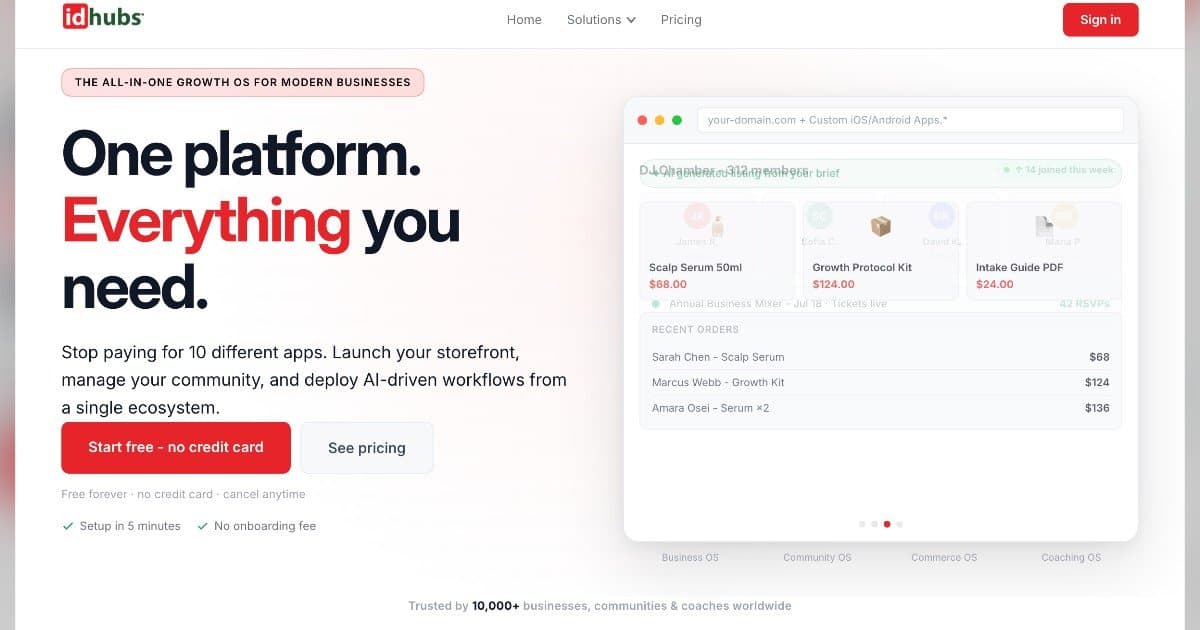
idhubs offers a natively unified operating system with core functions—CRM, e-commerce, community, invoicing, and AI—on a single shared data layer. It also provides a white-label community and social commerce layer. “When you build your community on a third-party social platform, you rent your audience; you don’t own the data, you don’t control the algorithm and you can’t monetize without a cut taken off the top,” Fears said. With idhubs, organizations own the relationship and data, turning discussions into transactions without leaving the branded environment.
Security is a key concern. Sorokhaibam explained that idhubs runs a permissioned, private Hyperledger Fabric network underneath the platform. “Think of a public blockchain as a town square where everyone sees every transaction; this is the opposite,” he said. Using channels and private data collections, sensitive records are visible only to authorized nodes, neutralizing single-point-of-failure risks. He also addressed performance: “We don’t store heavy payloads on the ledger itself; we use off-chain storage for large files and media, while the ledger only cryptographically anchors the state changes and audit trails.” This provides military-grade auditability without slowing the user interface.
The company reports more than 50,000 registered users acquired organically, with a total addressable market of roughly $158 billion. Its leadership team includes three-time exited CTO Sorokhaibam and Fears, who has launched over $2 billion in products. Pricing is a flat, predictable annual rate that scales with organizational capacity and transactional volume, not headcount. “We specifically killed the per-seat pricing model because it punishes companies for scaling their teams,” Fears said.
Skeptics question whether a unified platform can match best-of-breed depth. Sorokhaibam countered that idhubs builds deep, API-first modules, citing native multi-currency and automated tax compliance. For niche workflows, customers can build custom extensions on the unified data layer. Migration is another hurdle, but Fears said idhubs engineered automated pipelines for incumbents like HubSpot, QuickBooks, Salesforce, and Slack, running parallel environments to measure time-to-value in days, not quarters.
As for competition from suites like Zoho and HubSpot, Sorokhaibam argued they were built as separate apps glued together. “They are a suite of tools trying to act like an OS. We are a single, secure operating system,” he said. “In the AI era, context is the whole game.” The ripple effect, he added, would be that software becomes a silent partner, eliminating the integration tax and freeing human capital for strategy. For more information, visit idhubs.
