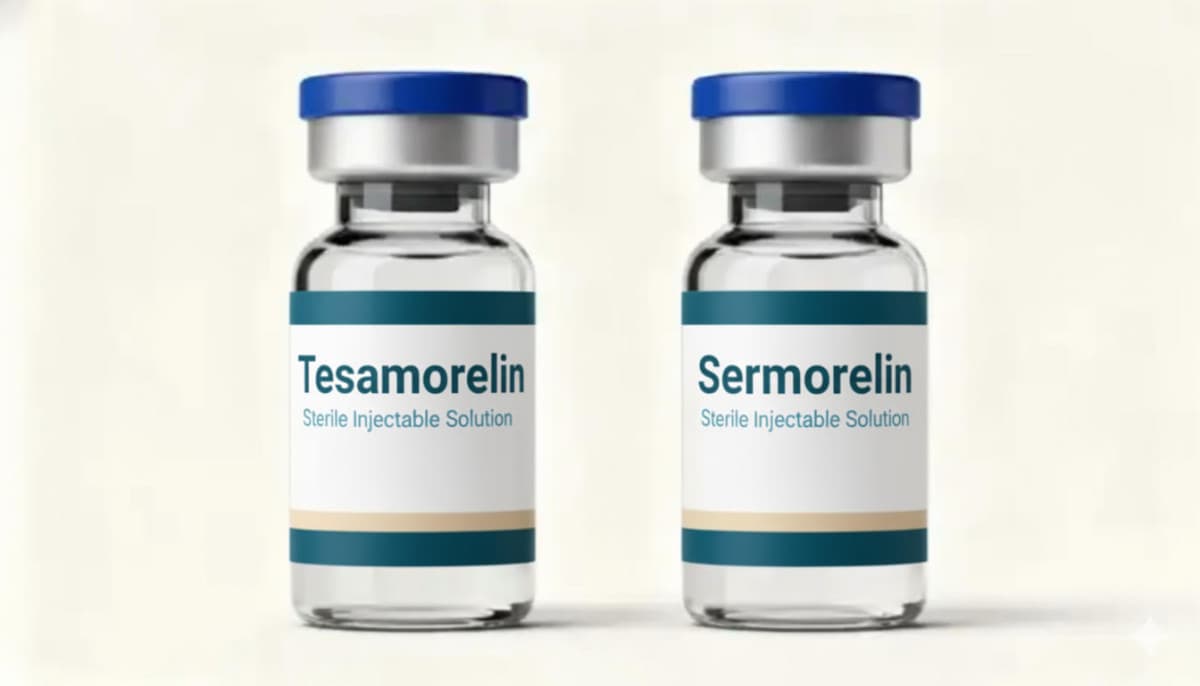
Tesamorelin and Sermorelin represent two distinct synthetic variants of growth hormone-releasing hormone that offer researchers different approaches to studying growth hormone effects in experimental settings. Both peptides interact with pituitary receptors to promote growth hormone release but exhibit fundamentally different structural characteristics and pharmacological profiles that determine their research applications.
Tesamorelin consists of 44 amino acids and features a stabilized analog design that enhances receptor affinity and extends half-life. This structural configuration allows for sustained receptor engagement, resulting in prolonged downstream activity of growth hormone and IGF-1. In research environments, this profile has been linked to targeted lipolytic effects in visceral adipose tissue and observable alterations in metabolic signaling markers. The sustained stimulation provided by Tesamorelin supports research focused on visceral adipose modulation and prolonged anabolic signaling pathways.
Sermorelin presents a contrasting approach as a 29-amino-acid fragment corresponding to the endogenous GHRH(1-29). This shorter sequence promotes growth hormone release from the pituitary in a pulsatile manner that closely resembles natural secretion patterns. This physiological rhythm leads to intermittent spikes in growth hormone and IGF-1 levels, which may affect recovery, metabolic signaling, and anabolic pathways in research models where rhythmic stimulation is pertinent. Sermorelin's pulsatile pattern makes it advantageous for studies investigating physiological growth hormone dynamics, endocrine rhythms, and tissue recovery mechanisms.
The pharmacological differences between these peptides extend to their experimental applications. Tesamorelin's sustained receptor occupancy and consistent downstream signaling make it particularly suitable for studies requiring prolonged growth hormone and IGF-1 elevations or for examining effects on visceral adipose tissue and metabolic markers. Meanwhile, Sermorelin preserves natural secretion patterns, supporting research into the temporal dynamics of growth hormone-dependent pathways and feedback mechanisms.
Both peptides require careful handling and storage considerations to maintain stability. Lyophilized peptides should be stored at low temperatures between -20°C to -80°C, protected from moisture and light. Reconstituted peptides require immediate preparation in sterile conditions with appropriate solvents such as sterile water, bacteriostatic water, or small amounts of DMSO for hydrophobic sequences. Tesamorelin's stabilized modifications enhance shelf-life but necessitate monitoring for chemical degradation when exposed to elevated temperatures or repeated freeze-thaw cycles. Sermorelin's shorter, less modified sequence may be more susceptible to aggregation under high concentrations or unfavorable solvent conditions.
Researchers must consider solubility and reconstitution protocols, dissolving peptides gently along vial walls to minimize foaming and using gentle swirling or flicking rather than vortexing. For poorly soluble peptides, brief sonication or the addition of minimal co-solvents may be necessary. Proper documentation including peptide details, concentration, solvent, and preparation date ensures experimental reproducibility. The choice between these peptides ultimately depends on research objectives, with Tesamorelin offering continuous lipolytic and metabolic signals while Sermorelin provides pulsatile endocrine regulation. Future research directions may include combination studies with other growth hormone secretagogues or metabolic modulators to reveal additive or synergistic signaling effects. Additional information about these research compounds is available through https://lotilabs.com.