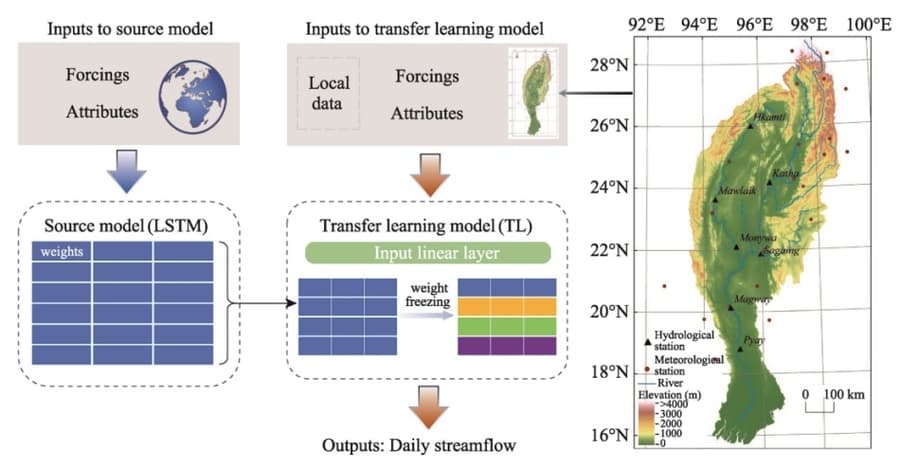
Researchers have unveiled a transformative model leveraging transfer learning to significantly improve daily streamflow forecasts. This development addresses critical challenges in water resource management and climate change mitigation, particularly in data-scarce transboundary basins.
Streamflow modeling, essential for securing water supplies and understanding climate change impacts, has historically been hindered by the uneven global distribution of gauges and limited data in extensive transboundary regions. The new model, presented in a landmark publication in the Journal of Geographical Sciences, addresses these gaps by excelling in under-researched areas like the Dulong-Irrawaddy River Basin.
The joint research team from Yunnan University and Pennsylvania State University tested the transfer learning framework in the Dulong-Irrawaddy River Basin, demonstrating its superior performance over traditional models. The framework's sensitivity analysis and integrated gradients analysis highlight its ability to capture complex, nonlinear interactions and diverse flow patterns, promising to deepen our understanding of large-scale hydrological processes.
Dr. Ma Kai, a principal investigator and co-author, emphasized the study's significance: "This research not only meets the urgent demand for reliable streamflow predictions in regions with limited data but also paves the way for a more profound comprehension of the complex dynamics governing our hydrological systems."
This breakthrough is poised to revolutionize water resource stewardship in transboundary basins, offering robust solutions to data scarcity and climate change challenges. The transfer learning model represents a paradigm shift in water resource forecasting, potentially fortifying water security in vulnerable regions.