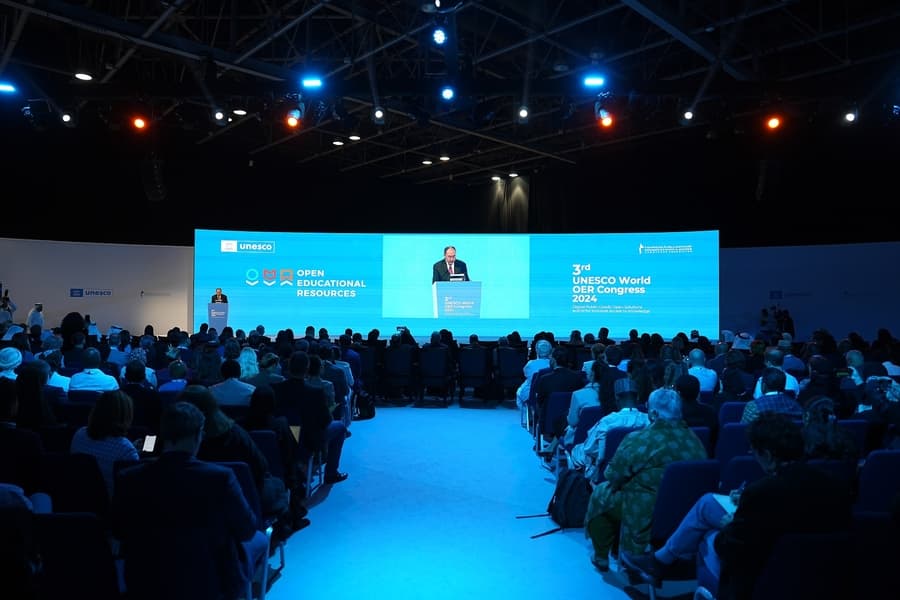
The 3rd UNESCO World Open Educational Resources (OER) Congress commenced today at the Dubai World Trade Centre, marking its first occurrence in the Arab World. Organized by UNESCO in collaboration with the Mohammed bin Rashid Al Maktoum Knowledge Foundation (MBRF), the two-day event has drawn over 500 global participants, including ministers, academics, and private sector representatives.
Under the theme 'Digital Public Goods: Open Solutions and AI for Inclusive Access to Knowledge,' the Congress aims to advance equitable, sustainable education through OER and emerging technologies. The event features high-level panels, breakout sessions, and expert discussions on topics ranging from AI's role in education to the implementation of UNESCO's 2019 OER recommendations.
Key discussions included a ministerial panel on shaping the future of education, chaired by Louise Haxthausen, Director of UNESCO Nairobi. The panel explored policies for openly licensed learning content, with participation from education ministers and officials from countries such as Ghana, Burkina Faso, China, Maldives, Cambodia, and Guyana.
Another significant panel focused on harnessing OER and generative AI for digital inclusion. Experts, including Dr. Phumzile Mlambo-Ngcuka, former UN Under-Secretary-General, discussed the potential of AI and OER to address global challenges, particularly in promoting gender parity and language inclusion in education.
The Congress also featured breakout sessions on implementing UNESCO's 2019 Recommendation on OER, covering areas such as capacity building, policy development, quality assurance, and sustainability of OER initiatives. These sessions emphasized inclusivity, addressing the needs of vulnerable groups and regions like Africa, least developed countries, and Small Island Developing States.
The event highlights the growing importance of OER and AI in shaping the future of global education. By bringing together diverse stakeholders, the Congress aims to establish guidelines for promoting openly licensed content and addressing challenges arising from emerging technologies. The anticipated Dubai Declaration for Action on OER is expected to outline concrete steps for advancing inclusive and equitable quality education worldwide.
This Congress underscores the critical role of open educational resources and artificial intelligence in democratizing access to knowledge and addressing global educational challenges. As countries showcase their progress in implementing UNESCO's OER recommendations, the event serves as a catalyst for innovative approaches to education, potentially transforming learning experiences and opportunities on a global scale.