

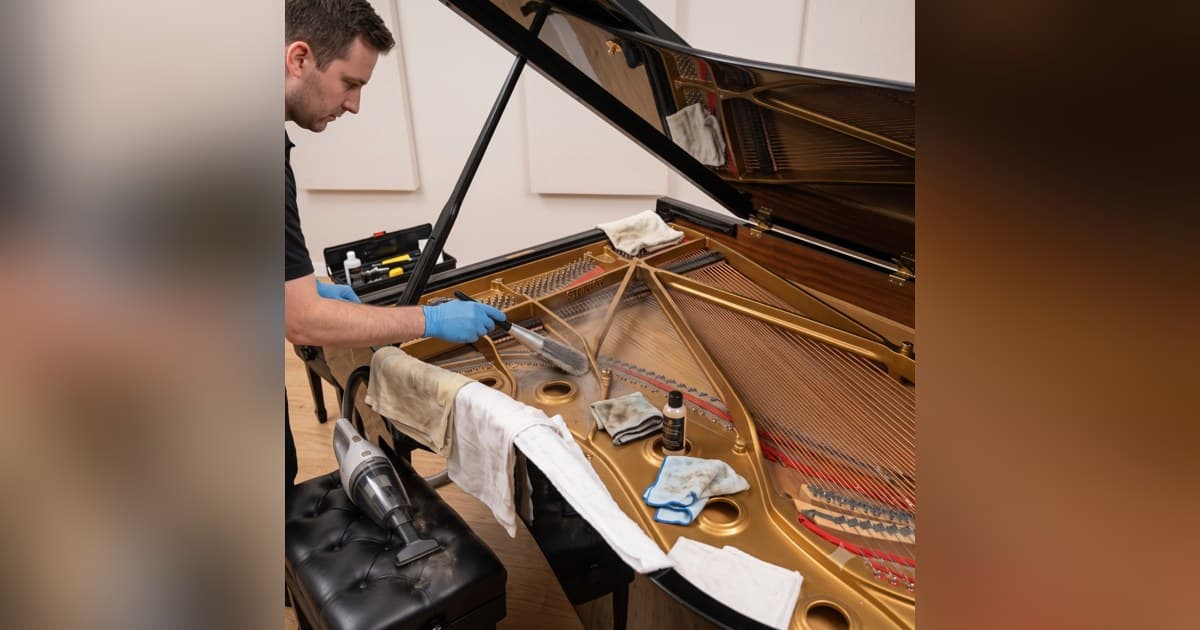
Dust does not stay on the lid of a piano. It settles on the soundboard under the strings, works down into the key bed, and packs into the felt and wood of the action, where a dust rag never reaches. Moore Piano, headquartered in Fort Wayne, has outlined what a professional Piano Cleaning actually covers, so owners across Northeast Indiana and Northwest Ohio know exactly what they are paying for before they schedule.
Most people picture furniture polish and a clean set of keys, which is the part of the job that takes the least time and makes the least difference to how the piano plays. A piano in a living room gets dusted along the lid, the fallboard, and the music desk. Those are the surfaces people see and touch. Everything below them is sealed inside a wooden box that nobody opens.
Under the strings of a grand, dust builds into a gray film across the soundboard and settles along the bridges. In an upright, it collects on the bottom board behind the lower panel, along with whatever has slipped past the keys over the years. Technicians routinely pull pencils, guitar picks, coins, hair ties, paper clips, and candy wrappers out of uprights. In a school practice room, the list gets longer.
Regional conditions shape what a technician finds. Summers here are humid, winters run dry under forced-air heat, and that swing moves moisture in and out of the wood and felt all year. Dust that stays damp behaves differently than dust that stays dry, and both leave residue in the action. Homes with pets add hair, which wraps around action parts and collects in the key bed. Pianos stored in barns, garages, church basements, and outbuildings across rural Allen, DeKalb, Whitley, Defiance, and Paulding counties often come with rodent evidence, nesting material in the bottom of the case, and chewed felt.
Key cleaning starts with identifying what the keys are made of. Ivory and plastic do not get cleaned the same way. Ivory is porous, it absorbs liquid, and it reacts badly to ammonia, bleach, and alcohol. Soaking an ivory key top can lift it off the key stick or cause it to crack along the grain. Plastic key tops tolerate more, but the sides of the keys, the spaces between them, and the fronts are where the real grime sits. Oil from hands migrates down the key sides where no one wipes, and over time it holds dust in a dark band along the edge of each white key.
The action collects the most dust and tolerates it the least. A piano action has thousands of moving parts, and most of them pivot on a metal pin running through a cloth bushing. Dust is abrasive. When it gets into those bushings, friction increases, and the owner feels it as keys that feel sluggish, uneven, or slow to repeat. Hammers collect dust in the felt alongside the string grooves they cut over years of playing. Dampers collect it too, and a dirty damper felt can leave a note ringing slightly after the key is released.
Owners who want a fuller breakdown of the piano cleaning process can read through it before deciding how far they want a technician to go. In a grand piano, the soundboard sits beneath roughly 230 strings strung across it at high tension. There is no way to wipe it with a hand. Technicians use thin flexible tools with cloth attached, worked between the strings and drawn across the board in sections. The plate, the gold-colored cast iron frame, holds dust along its struts and around the tuning pins. Strings themselves collect it in the speaking length and along the bass windings, where accumulated dust and surface corrosion dull the tone of the lower octaves.
Moore Piano cleans instruments of every size and type: spinets, consoles, uprights, baby grands, concert grands, digital pianos, and acoustic pianos fitted with player systems. Digital instruments have their own requirements. Liquid cannot be sprayed anywhere near the key contacts or the control panel, and the key action on a weighted digital still collects dust under the keys even though there are no strings involved.
Cleaning is frequently paired with tuning in the same visit. Moving the action, removing keys, and clearing debris can change how the instrument responds, and a tuning afterward makes sense for most acoustic pianos. Scheduling typically runs one to seven days out. Moore Piano serves Fort Wayne and the surrounding counties in Northeast Indiana along with communities across Northwest Ohio, offering piano tuning, repair, restoration, and cleaning for acoustic, digital, and player instruments. Service details, customer reviews, and current availability are listed with Moore Piano in Fort Wayne, and appointments generally open within one to seven days.
