

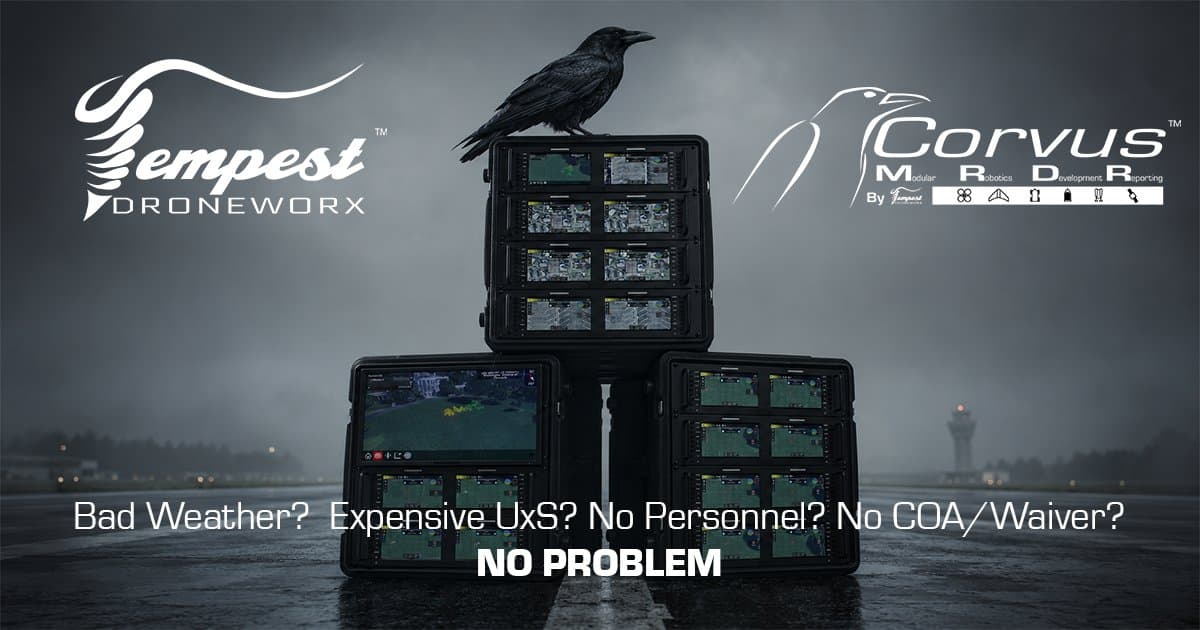
Tempest Droneworx™ has announced the commercial availability of Corvus MRDR™ (Modular Robotics Development & Reporting), a platform designed to streamline the development of autonomous systems by allowing engineers to start with simulated vehicles and progressively replace them with real ones. The product, initially created for internal use, is now being offered to researchers, developers, and government agencies.
The Corvus MRDR™ addresses a common pain point in autonomous systems development: the significant time and expense required to conduct field tests. Traditionally, developers must assemble aircraft, crews, ranges, and coordinate travel and weather, all before they can test their algorithms. Corvus MRDR™ changes this by enabling a team to begin with 20 simulated aircraft operating in real-world coordinates. As confidence grows, they can replace one simulated vehicle with a physical aircraft, test again, and continue this process until the entire fleet is real. This approach allows for rapid iteration and reduces the risk of damaging expensive hardware during early development stages.
The platform works alongside a customer's existing tools and control architecture, ensuring that they retain ownership of their algorithms, methodologies, workflows, and intellectual property. “We're not commercializing our control algorithms. We're commercializing the engineering environment that helped us build them,” said Ty Audronis, Chief Technology Officer of Tempest Droneworx™. He added, “Corvus MRDR™ gave us the freedom to try more ideas, fail without breaking expensive hardware, and go to the field when we were ready—not because we needed the field to find out if something worked.”
The technology behind Corvus MRDR™ has evolved through years of real-world engineering, including work on the FAA BAA 4 One-to-Many Command and Control project. It currently supports PX4 and ArduPilot through distributed Core Robotics Object Simulators (CROS), with new firmware types in beta and future updates anticipated.
A key feature is the Robotics Aggregation & Visualization Node (RAVN), which combines simulated and physical vehicle telemetry with ADS-B, Remote ID, RADAR, and other sources in a real-time 3D environment. Missions can be recorded and replayed for analysis, providing a comprehensive view of operations.
The product line includes the MRDR-1, stackable MRDR-2 Expansion systems, and the eight-display MRDR-187 Enterprise. NDAA-compliant configurations are available. The first MRDR-187 Enterprise has already been delivered to the University of Houston Robotics Department.
Dr. Dana Abramovitz, Chief Executive Officer of Tempest Droneworx™, emphasized the broader significance: “The next generation of autonomous systems won't be built by any one company working alone. By making Corvus MRDR™ available, we're giving researchers, developers, industry, and government another tool to move faster and advance the next generation of autonomous systems together.”
Corvus MRDR™ is available for pre-order now, with commercial deliveries beginning in October 2026. Corvus MRDR™ Defense, which includes additional defense-specific capabilities, is scheduled for December 2026. The Corvus Platform Pipeline Beta Program is also open for early access to features under development. For demonstrations and pre-orders, visit www.tempestdroneworx.com.
